
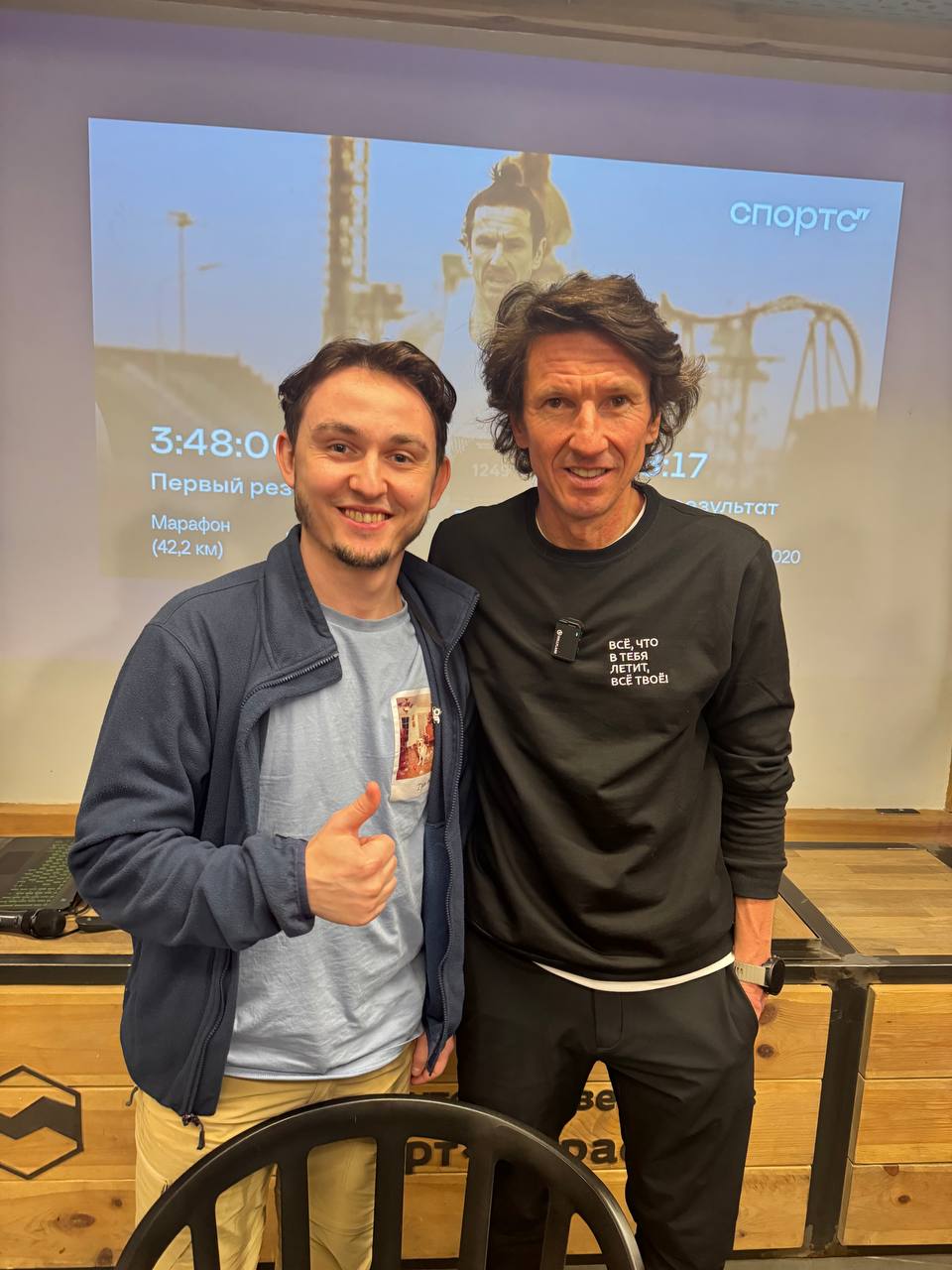
Yesterday I was at a lecture by Alexey Smertin
He used to be the captain of the Russian national team, played for Lokomotiv, Bordeaux and Chelsea
And now he's an ultramarathon runner
He ran 252 km across the Sahara (“We were lucky. It was only 47°C. They promised 52°C.” Lucky guy))
50 km in Oymyakon (the coldest inhabited place on Earth) at -50°C.
He ran all the major marathons
In short, as the meeting moderator joked yesterday, “You are witnessing a rare phenomenon - Alexey is sitting”
The most important thing I got yesterday was a surge of motivation. From Alexey, from the people around (most are runners too).
The recording will be on the Sport-Marathon YouTube channel within a month.
For now, I'll share what I remember:
1. A little about football (there were many allegories through it)
- I was once again convinced that defensive midfielders are the most important people on the field. They are the brain and engine of the team. They are often the smartest people on the team. They are both playmakers and leaders.
At some point, he realized that he couldn't compete with the top players in skill. He made up for it with hard work and intelligence.
- “Do you know which football players sleep the worst?
Goalkeepers. Because they run very little during a game, about 200 meters. They have energy left. And then they replay the game in their heads all night. But we, defensive midfielders, run almost 15 km and go to sleep peacefully.”
2. There was a lot about health/psychology
- He talked about one method of tricking the brain while running. There was 1.5 hours left to the finish, and he needed to distract his brain from the pain. So he went into a fantasy. For 1.5 hours, he imagined in his head that he was a great bass guitarist and played it out in various ways.
- I really liked his phrase (borrowed from the famous doctor Amosov) Doctors treat diseases, but health must be earned by yourself
- Someone from the audience said that doctors should examine his muscles as a scientific phenomenon. He is too resilient.
3. And about the marathons themselves: about daily life, emotions during/after, about injuries, about the body-mind connection
And he told it quite matter-of-factly:
- About blisters in the Sahara.
“There was nothing supernatural. At the end of the day, I would go into the medical tent, and there were two signs: 'small blisters' and 'large blisters' (I don't remember the exact names). I went to the small blisters. I would puncture them and use a syringe to inject a special solution inside. Just routine. At such distances, you get used to pain.”
- He also quoted Murakami: Pain is inevitable. Suffering is a personal choice.
Actually, there is a lot more to say about the meeting. He talked very interestingly about his runs, about football, and about how his father coached him in football.
We would go to the box and he would kick balls at me, saying: 'Everything that flies at you is yours!'
Comments
0No comments yet.
Sign in to join the discussion.