
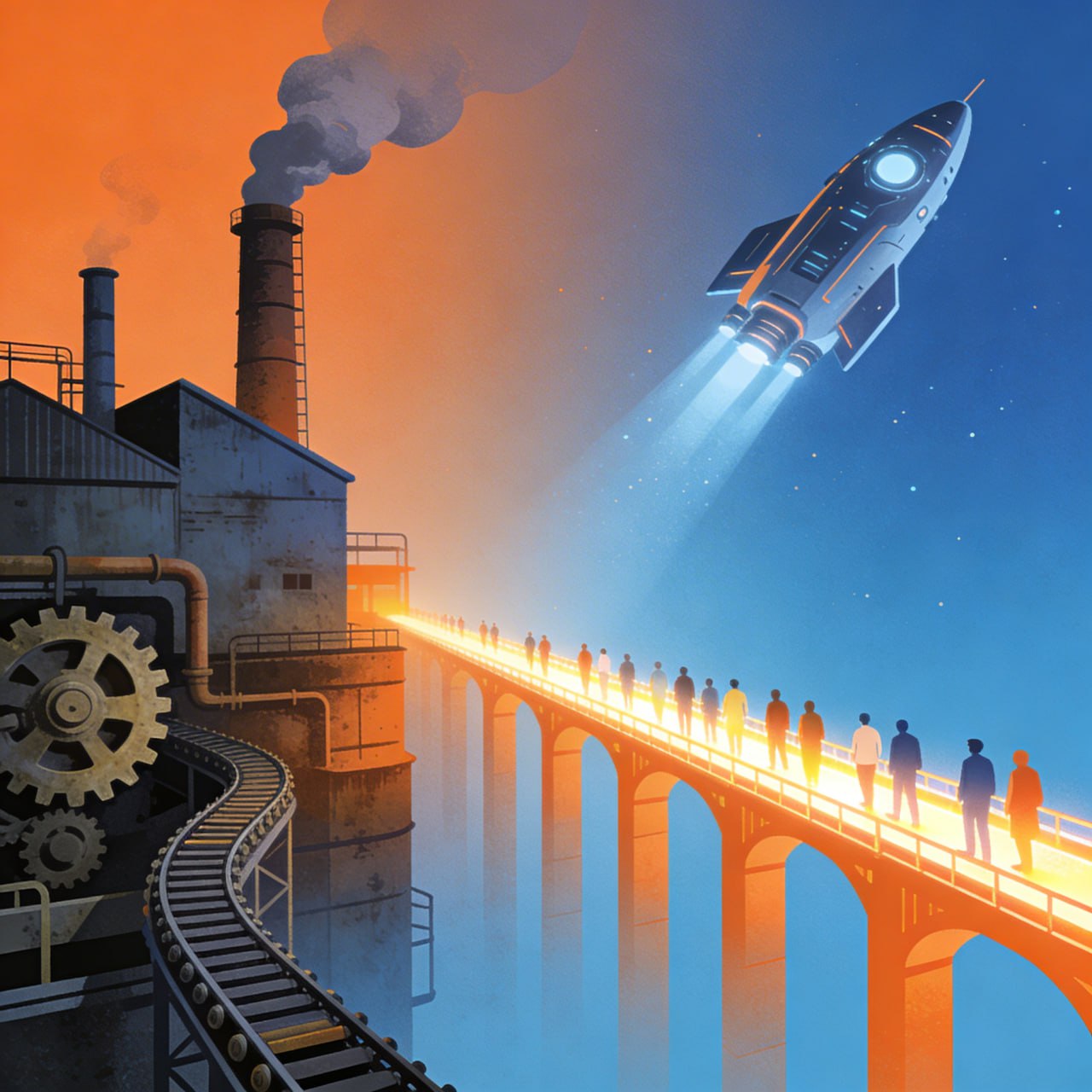
🚀 Spaceship vs. Factory: When Digital Transformation Becomes 'Overdrive'
Over 10 years of working with digital transformation in financial organizations, I keep seeing the same picture: the IT team pulls the organization forward—toward market standards, automation, new products. And at first glance, everything is right: labor costs are reduced, development accelerates, engagement increases.
But there is a downside. You constantly break not only processes but also people. Employees don't want to learn new systems, change their thinking paradigms, or switch to other management tools. And here arises a metaphor I call 'spaceship vs. factory.'
🏭 A factory is a stable business: it brings in money, processes are clear, risks are minimal.
🚀 A spaceship is IT initiatives: technology, speed, new horizons.
And most often, the spaceship loses. Because to the business, it looks like risk, while the factory looks like reliability. When the speed of production (upstream) exceeds the ability of users (downstream) to adapt, the system begins to break down. An 'invisible backlog' accumulates—work is done but not accepted. Features are rolled out but no one needs them. Progress exists, but no one feels it.
And unfortunately, we often don't notice that this is about our own organization.
⚠️ Why 'Overdrive' Becomes the Norm
When the IT team works with modern technologies while the organization lives in a decade-old paradigm, engineer motivation drops. Research shows that 86% of senior developers feel embarrassed about their current tech stack, and 58% are ready to quit due to legacy systems. No one wants to build semi-automated processes and 'fix' what should have been rewritten long ago. Developers want to grow, not maintain a museum.
Developers want to build, not maintain.
🔑 How to Try to Get Out of the 'Overdrive' Situation:
🎯 Assess the company's readiness BEFORE starting transformation
The organization must either be ready or purposefully prepare for digital transformation—and only then enter it. Start with a cultural diagnosis: how ready is management to put personal effort into changes, what is the digital maturity level of employees. 70% of digital transformations fail precisely due to the human factor.
🎯 Regulate speed, not stop
Don't slow down, but be selective.
Not everything needs to be 'sold' inside the organization at once. Otherwise, 'feature fatigue' sets in—people start ignoring any changes.
🎯 Build discovery from within, not impose from above
The most powerful tool for change adoption is involvement. When employees participate in design and implementation, resistance transforms into ownership. Conduct workshops, pilot programs, appoint 'change champions'—trusted employees who support colleagues and reduce anxiety. Nailing things to users' hands doesn't work.
🎯 Give the team a modernization roadmap
Engineers don't expect a perfect stack—they expect forward movement. Having a clear modernization roadmap with a real budget is the main retention strategy. If your developers look at what other companies are doing and wonder why they aren't part of that movement—you won't keep them.
Comments
0No comments yet.