
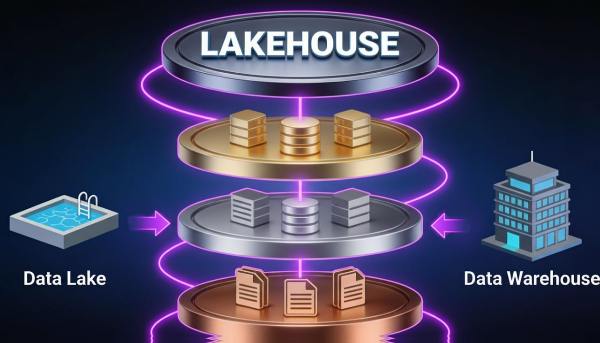
🏠 Lakehouse: The Union of Data Lake and Warehouse
Data architecture has gone through three eras:
1️⃣ Data Warehouse — strict structure, ACID transactions, powerful analytics. But expensive and only structured data.
2️⃣ Data Lake — cheap storage of any data on object storage. But without transactions and quality control, the lake quickly turns into a "swamp".
3️⃣ Data Lakehouse — the best of both worlds. A unified platform that combines the flexibility of a lake and the reliability of a warehouse.
🌐 What does Lakehouse provide?
• Cheap storage (S3, ADLS, GCS)
• ACID transactions on top of files (Parquet/ORC)
• Flexible schema evolution (Schema Evolution)
• Support for BI, ML/AI, and streaming on a single copy of data
🌐 Key Platforms
• Databricks + Delta Lake — maximum performance (Photon), built-in MLflow and Unity Catalog
• Snowflake — leader in BI, native support for Apache Iceberg
• Apache Iceberg — open format, free license, industry standard for multi-engine access
🌐 Medallion Architecture (Bronze → Silver → Gold)
🥉 Bronze — raw data "as is", append-only, full history for audit and reprocessing.
🥈 Silver — cleaning, deduplication, normalization. Data is validated and suitable for analysis.
🥇 Gold — business aggregates, KPIs, dashboards. Ready tables for analysts and stakeholders.
🌐 3 Steps to Implement Lakehouse
1. Choose an open format (Iceberg/Delta) and cloud storage — this is the foundation that protects against vendor lock-in.
2. Organize data by Medallion layers — Bronze for ingestion, Silver for cleaning, Gold for business metrics.
3. Connect a unified catalog and governance — access control, data lineage tracking, and data quality management from day one
🌐 Examples of Lakehouse application in Russian companies:
1. Magnit
2. "AB Tech" for an unnamed construction holding
#DataArchitecture #Lakehouse #DataEngineering #Analytics
Comments
0No comments yet.
Sign in to join the discussion.