
Scientists have made progress in developing high-temperature polymer dielectrics for energy storage capacitors.
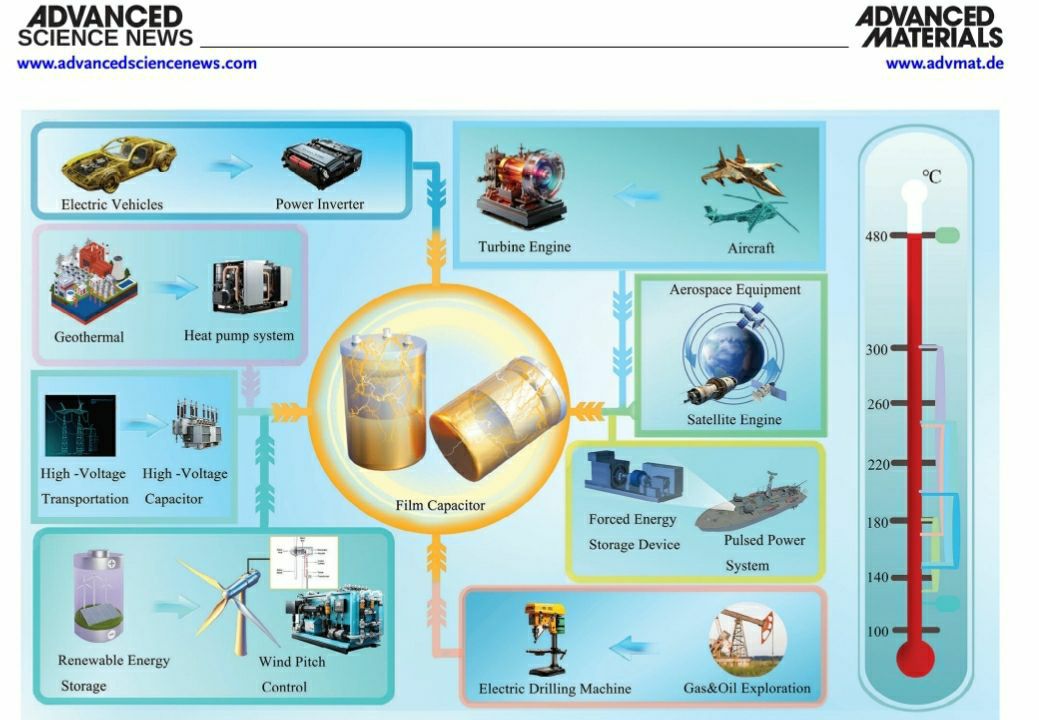
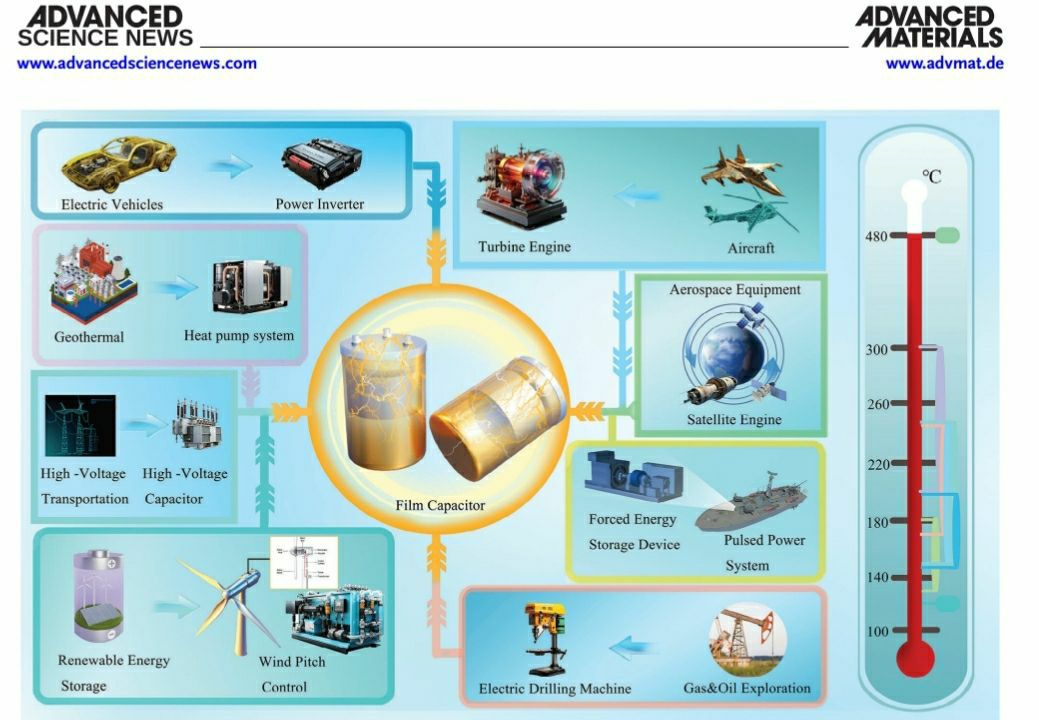
Modern energy systems, such as:
1. Power electronics of electric vehicles
2. Aviation and space technology
3. Equipment for oil and gas exploration
Require capacitors capable of stable operation at temperatures from 150 to 250 °C and above.
Existing commercial dielectrics based on biaxially oriented polypropylene (BOPP) do not meet these requirements due to low operating temperature (≈105 °C) and low energy density (< 2 J/cm³).
Which materials are promising?
Polymers with high thermal stability and glass transition are being investigated as a basis for high-temperature dielectrics:
· Polyimides (PI, T_g ≈ 360 °C)
· Polyetherimides (PEI, T_g ≈ 217 °C)
· Fluorinated polyethers (FPE, T_g ≈ 330 °C)
· Polyetherketones (PEEK, PEKK) and other aromatic thermoplastics.
To overcome the fundamental trade-off between dielectric permittivity and breakdown strength, three main strategies are used:
1. Filling with inorganic particles (Al2O3).
2. Chemical modification of molecular chains (embedding special polar functional groups).
3. Creating multilayer structures from different polymers or composites.
Results and current achievements:
Lab samples demonstrate high released energy density of 8.1 J/cm³ at 150 °C and 7.2 J/cm³ at 200 °C with efficiency above 90%.
Despite the successes, there remains a significant gap between laboratory research and mass production.
Key tasks for the future are the development of cost-effective and scalable technologies for producing thin (3–10 μm) defect-free films, as well as optimization of capacitor design to minimize parasitic parameters and ensure efficient heat dissipation.
Comments
0No comments yet.
Sign in to join the discussion.