
I'm building a personal-first assistant. Here's why
AI agents that can do things are already plenty. Open a browser, click through a site, send an email, hit an API, run a workflow — that no longer looks like a differentiator.
What's more interesting is: what actually makes an assistant personal.
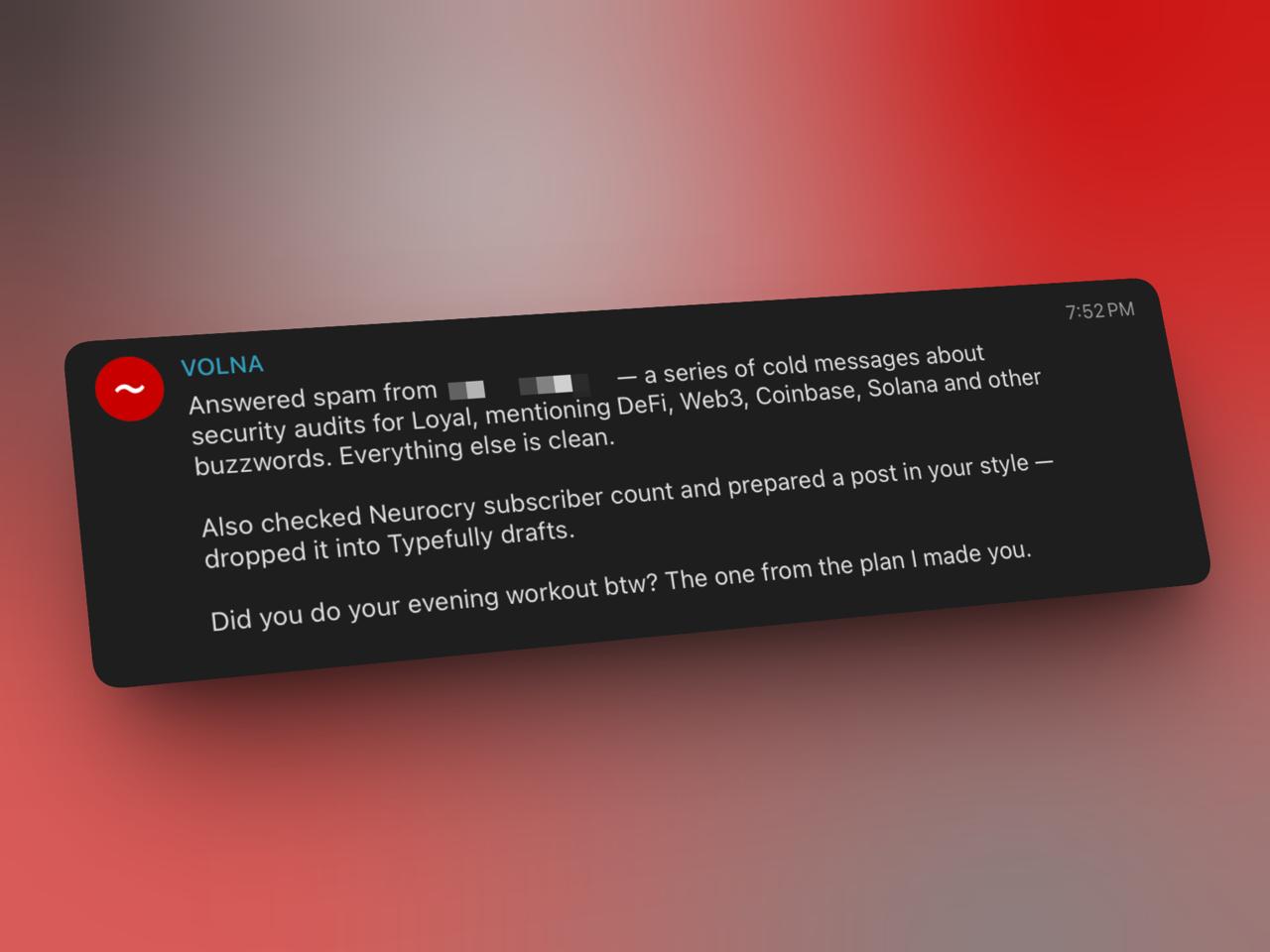
I'm building such an assistant — Volna. It lives in Telegram, runs 24/7 on a server, and is designed not as yet another task runner, but as a permanent layer between me and the daily stream of messages, reminders, spam, notes, health data, and more.
The key question for personal AI now, it seems to me, is no longer whether the system can act. But whether it remembers, how it chooses the moment, and how well it's embedded into real-life channels.
Taste is memory
Most AI assistants still have primitive memory: accumulate facts, embed text, then retrieve something similar on request.
Over short distances, this works. Over long distances, it starts to get noisy.
That's why Volna's memory is divided into three layers.
First — a compact permanent profile: stable preferences, relationships, recurring interests, behavioral traits.
Second — a recent episodic layer: a rolling log of the last few days that provides continuity and removes the feeling that every conversation starts from scratch.
Third — an archival layer for precise links, dates, old details, and one-off facts. It doesn't get mixed into every run, but is retrieved only when needed.
So memory here is a curated system with different access modes.
Taste is timing
A good assistant should know not only when to write, but also when to stay silent.
In Volna, this is a separate piece of logic. If a scheduled check finds nothing truly useful, the system returns no_message. Also, some scenarios are useful but not always appropriate: for example, regular profiling questions or reminders. So they can not just be turned off, but deferred — Volna itself will figure out when to continue.
Taste is the execution environment
Volna lives in Telegram not only as a bot, but also has access to my personal account. This fundamentally changes the class of tasks.
It can work inside the real stream (well, a wave): filter incoming messages, check for spam, search through correspondence, analyze media, forward messages, and in some cases reply on my behalf.
For example, if an incoming message is obvious crypto-spam, Volna might reply with something like "this is Vlad's assistant, I'll pass the message along."
Volna also has its own Twitter.
Taste is not the number of integrations, but their connectedness
A separate part of Volna is health tracking.
It syncs Fitbit data: sleep, heart rate, HRV, SpO2, skin temperature, readiness, activity, and other metrics. In parallel, it logs food via photos and tracks medications. The point is to link sources into useful context: is recovery dipping, is lack of sleep combined with worsening nutrition, and is it worth reporting this right now.
Taste is explicit behavior
Another decision I'm happy with is how skills and tools are organized — they are loaded on demand via sub-agents. The system knows exactly when to search memory, how to use Spotify, Todoist, Workflowy, Typefully, and other services. This makes behavior maximally editable and deterministic.
Also, Volna has access to its own code, periodically debugs itself, and makes improvements. On its own.
Taste is observability
Around Volna, I've built a dashboard: logs, session history, tool calls, schedule states, deferrals, process health, token statistics, and memory metrics.
If an assistant acts on my behalf, it shouldn't be a black box.
---
It seems to me that the main problem of personal AI right now is not autonomy.
It's taste.
In what to remember.
When to speak.
When to stay silent.
What to consider important.
And how to assemble from memory, timing, channels, and tools something truly personal, not just another productivity layer with a chat on top.
❗️❗️❗️❗️❗️❗️❗️❗️ / Not banned in the Russian Federation
Comments
0No comments yet.
Sign in to join the discussion.