
“DevOps is dead? No, but something more powerful is taking its place.”
📊 Research predicts that by 2026, up to 80% of large product companies will have platform teams and internal developer platforms (IDPs) to maintain development speed amid growing infrastructure complexity. Currently, the adoption rate of Platform Engineering is estimated at about 55% among large organizations focused on creating digital products.
🧩 Paradigm Shift: From DevOps to IDP
Classic DevOps runs into the narrow skills of individual engineers and unique knowledge of “how things work here,” which scales poorly with many teams and microservices.
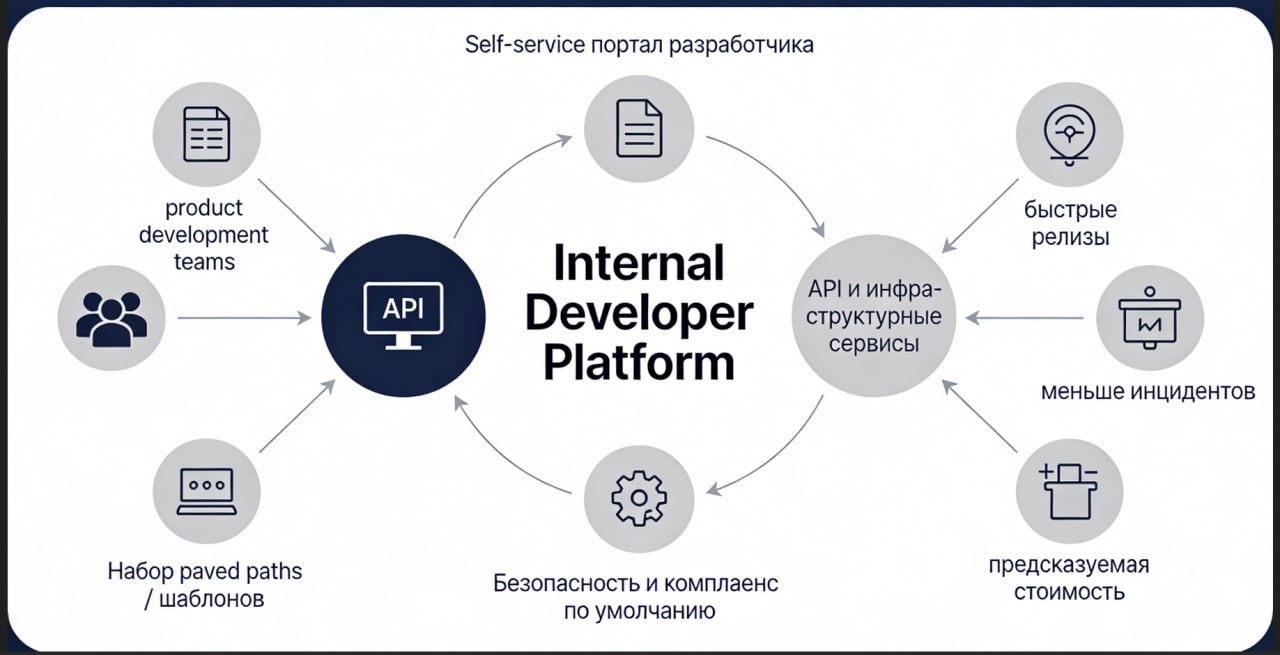
Internal Developer Platform (IDP) is the next evolutionary step: instead of a zoo of tools, teams get a single abstraction layer over infrastructure, CI/CD, logging, security, and observability with one entry point—a portal, CLI, or API.
🧱 Platform-as-a-Product and Golden Paths
The platform becomes a product for internal customers—developers: with a product manager, roadmap, documentation, SLA, and clear value.
The key mechanism is golden paths: ready-made service and pipeline templates with logging, monitoring, security checks, and guardrails configured by default, reducing cognitive load and accelerating time-to-market.
🇷🇺 Use Cases in the Russian Market:
T-Bank (Tinkoff) — transition from a fragmented IT landscape to a unified development platform: common pipelines, logging, monitoring, service catalog, and self-service for product teams.
VK Tech Dev Platform — a platform providing infrastructure, CI/CD, monitoring, and project management in a single solution (essentially an IDP).
Yandex / Yandex Cloud — Deploy Platform and internal developer platforms with common pipelines, release management, and infrastructure for dozens of teams.
#platformengineering #devops #idp #platformasaproduct #cloud #architecture #infrastructure #development
Comments
0No comments yet.
Sign in to join the discussion.