

While some are waiting for 'everything to stabilize,' others are quietly becoming the kings of their neighborhood. And it is the latter who, in two years, will dictate terms to the former.
I have been saying this for a long time, but now ignoring this strategy is simply dangerous for many, if not deadly.
Why the trend toward locality is the only chance.
Forget about scaling in the classical sense, especially in the form that the smart guys on stage are preaching. Forget about 'entering the federal market' and 'opening a chain of offline locations.'
It doesn't work. And it's not that you're doing something wrong. It's just that while we were all dreaming of scale and growth, times have changed, and significantly.
The rules of the game have fundamentally changed, and they changed yesterday—just not everyone noticed.
VAT increases, higher tax burden, departure of Western advertising platforms, degradation of social media algorithms, fraud in Yandex.Direct at 80%—all of this together has created an environment where medium-sized businesses are literally ceasing to exist as a class. Margins have hit rock bottom. Experiments in expansion have become an unaffordable luxury.
Marketplaces have finished off retail for good. Today, anyone can order two bolts cheaper than walking to the store across the street. The giants reduce logistics costs while simultaneously squeezing out everything built on the 'buy-sell' model.
What remains? Service. Manufacturing. Last-mile logistics. And everything related to live human contact that cannot be digitized and handed over to a robot (for now).
Only giants with venture billions, willing to operate at a loss for years to capture market share, can grow endlessly upward now. For everyone else, the task for the next five years sounds different: hold positions, increase efficiency, become indispensable where you already are.
And here is where the most interesting part begins.
The 15-Minute City Concept—and Why It's Your Main Chance.
In global urbanism, the concept of the '15-minute city' has long existed—a space where everything necessary for life is within walking distance. No trips to the other end of the city, no traffic jams, no wasted time.
This is not a utopia. It is what is already happening, whether we want it or not.
Traffic jams in Russian cities have become the norm. The cost of time has increased. People are less willing to travel to the city center for shopping and increasingly want to receive quality service near home—the kind that was previously only available in 'premium' locations. Developers have long understood this: modern residential complexes are designed as self-sufficient neighborhoods with infrastructure inside.
I adapt this concept for Russian small businesses and call it the local leadership strategy.
The essence is simple: become number one in your neighborhood within a one-kilometer radius. Not in the city. Not in the region. But in the neighborhood. For most local businesses, this is now not just an opportunity—it is a matter of survival.
What the Local Leadership Strategy Looks Like in Practice
This is not one tool or one mechanism. It is a system centered on live communication with the people around you.
Word-of-mouth marketing as the foundation. Not advertising, not targeting, not banners—but a reputation known by all the neighbors. When a mom in the stairwell tells a friend, 'There's a great bakery around the corner, they always remember my name'—that is worth more than any advertising budget. Word of mouth within a kilometer radius works fast, cheap, and with a high level of trust because it is recommended by a real person from the same environment.
Cross-marketing between neighboring businesses. A hair salon, coffee shop, fitness club, children's center, and pharmacy in the same block—these are not competitors for the same wallet. They are partners for the same audience. Sharing promotions, joint offers, cross-recommendations—all of this creates an ecosystem where each participant gets customers from the neighbor for free.

Only those who know how to strengthen each other will survive. Those who see a neighboring business as a threat rather than a resource have already lost—they just don't know it yet.
Neighborhood community as a marketing channel. One Telegram channel where residents discuss courtyard issues, child safety, landscaping—and there they also receive offers from local businesses. A lost-and-found board sits next to a coffee shop promotion. An announcement about a cleanup day stands next to the opening of a new location. This is not advertising—it is an organic part of neighborhood life where the business is naturally present.
Collaboration between businesses, residents, and the municipal sphere is not science fiction. It is the next logical step for those who want to become truly local in their territory.
Maps and ratings as the entry point. Yandex.Maps, 2GIS, Google Maps—for local businesses, these are not auxiliary tools but primary ones. A rating based on popular vote, live reviews, up-to-date photos, and a properly filled-out profile—this is the first thing a person sees when searching for 'coffee nearby' or 'haircut nearby' at two o'clock on a Friday afternoon. Here, it's not budgets that compete, but reputation and customer rapport.
Adaptability to customer needs. Understanding your customer not as an abstract target audience, but as a specific person from a specific building—with their rhythm of life, needs, and pain points. This means flexibility in formats, offers, and communication. And that includes flexibility in payments.
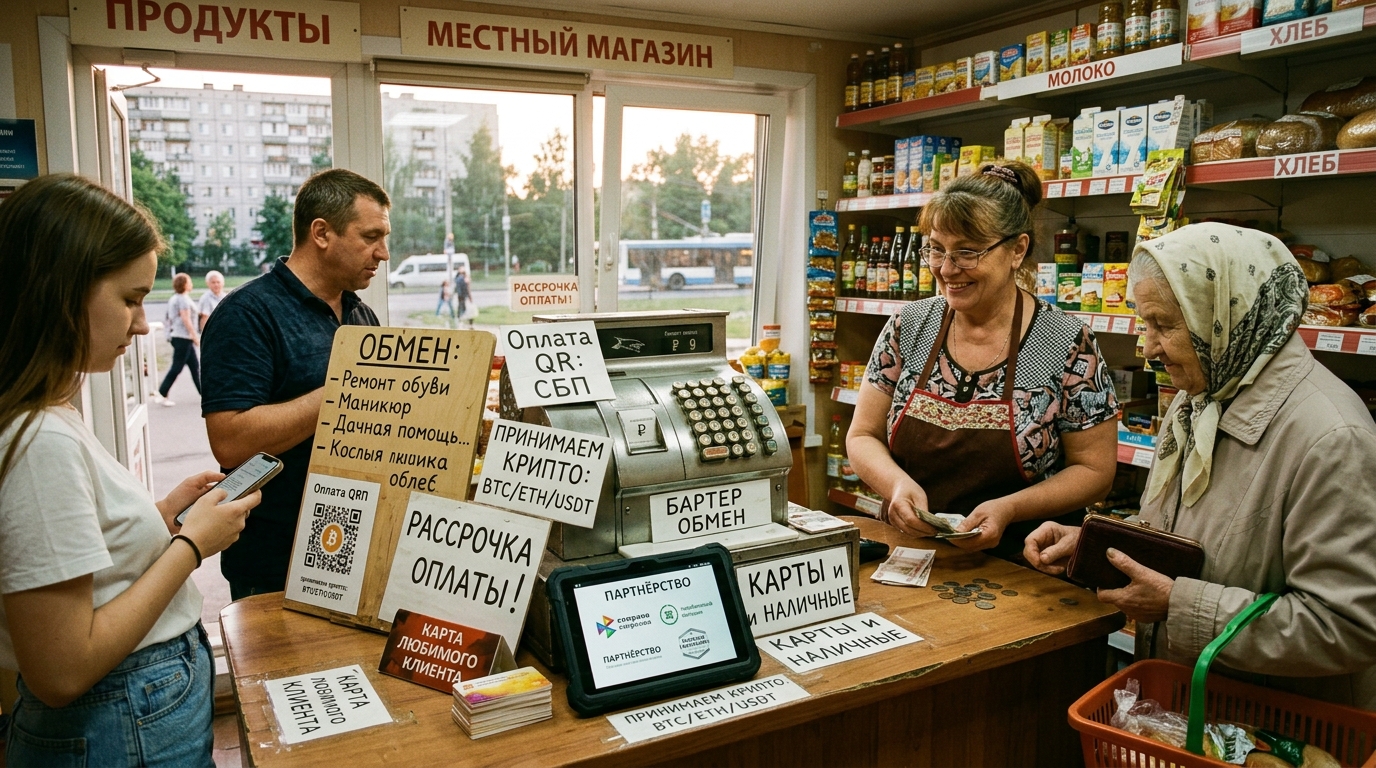
The ability to accept payment not only in money—this is not exotic, it is the reality of 2026-2030. Barter with a client, cryptocurrency, mutual offset of services, audience exchange—all these are tools that expand the possibilities for a transaction where classic payment for some reason does not work or is better 'not shown.' A business that knows how to negotiate survives. A business that only knows how to negotiate on its own terms does not.
The Employee as Part of the Marketing System
Here is a thesis that many will not like. But I will say it directly.
In local business, regulations give way to meaning. Labor rights take a back seat—not because they don't exist, but because the situation leaves no room for the attitude 'that's not my problem.'
If you work in a neighborhood coffee shop, you don't just make coffee. You are part of the system that keeps the business afloat. You are a bit of a sales department, a bit of a marketer, and a bit of your own employer. You are the face of the brand—both during working hours and when you walk home through the same courtyard where your customers live.
This is not exploitation. This is a new reality where teams that understand a common goal, rather than a set of functions in a job description, win. The sour-faced ones with a 'everyone owes me' philosophy will be the first to starve.
A team in a local business consists of people who basically know three things: solve problems, influence sales, and reduce costs. Not because it's written in the regulations, but because they understand: the owner bears all the risks, pays taxes and salaries—and that is why everyone on the team either helps the business live or drags it and themselves down.
From this grows a new format of corporate culture: joint team activities, client events, thematic collaborations—all of this works not for 'corporate spirit' but for concrete results in sales and customer loyalty.

You'll see... that's how it will be. AI will take over the boring routine, and humans will be the source of warmth and communication.
The Goal of Marketing in the New Reality
Let me put it as simply as possible.
The goal of local business marketing for the next 3 years is that every resident within a one-kilometer radius knows you exist, understands how you can be useful, and thinks of you the moment a need arises.
Not 'reach.' Not 'website traffic.' Not 'number of leads.' But a living presence in the minds and lives of the people around you.
This is achieved not through an advertising budget, but through constant visibility: word of mouth, maps, collaborations, content, participation in neighborhood life, quality of service, and human contact. All of this together forms what I call the word-of-mouth radius—a zone within which your name is known, recommended, and people return to you again.
Who Will Survive and Who Won't.
Those who stop waiting for a 'normal' market situation and start working with the one that exists will survive.
Those who see a neighboring business as a partner, not a competitor, will survive.
Those who build a team around meaning, not regulations, will survive.
Those who become truly local in their territory—indispensable, recognizable, recommended—will survive.
Scaling to the skies is not necessary now. You need to become the best where you already stand. That is the local leadership strategy—and in the current conditions, it works more reliably than any targeting.
Want to discuss how to implement the local leadership strategy in your business and on your territory? Write to me—we'll analyze it specifically, without templates.
Stas Esenin's channel about marketing in simple terms
Colleagues, what thoughts can you add to the concept before we put it into circulation? ))
Comentarios
0Aún no hay comentarios.
Inicia sesión para participar en la conversación.