
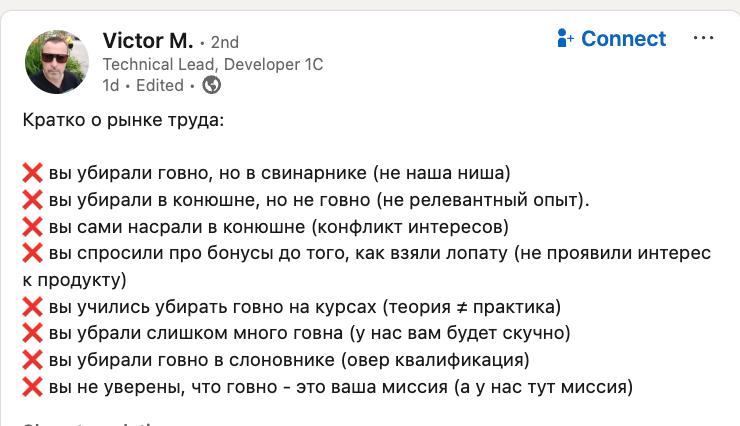
In the comments under the last post about the labor market crisis, Svyatoslav wrote:
“It’s hard with some cases if the experience is diverse, like mine. I’ve worked in medical startups, venture, IT, and government.”
This inspired me to write a post on this topic and even change the content plan. Thanks to Svyatoslav for the engagement and the idea.
As in “The Jungle Book”: “We be of one blood, thou and I.” I myself am such a specialist with diverse experience.
There are two key strategies for professional development: T-shape and I-shape. Imagine you’re in a video game and you need to distribute 10 points among 10 skills.
You can put all 10 points into one skill and get an I-shape specialist—a person with ultra-deep expertise in one professional area. This is the path of an incredibly narrow but incredibly strong profile.
For example, I’ve been told that this approach is popular in the US healthcare system. Not just a cardiac surgeon, but a cardiac surgeon who specializes specifically in coronary artery surgery. He has performed a thousand of them, knows almost everything about them, but is not strong in other areas of cardiac surgery. Another example: not just a lawyer, but a corporate lawyer specializing in M&A deals. A genius in mergers and acquisitions, knowing all possible nuances, but you’re doomed to get a sentence if you decide to hire him to defend you in court.
As Bruce Lee, Muhammad Ali, or even Vladimir Lenin said (this quote is attributed to many):
I fear not the man who has practiced 10,000 kicks once, but I fear the man who has practiced one kick 10,000 times.
Wow 🐺
The opposite strategy is the T-shape specialist, like me: a jack of all trades. Contrary to the common belief that it’s about “knowing a little about everything,” T-shape is a combination of deep knowledge in one area with competencies in related fields.
For example, a developer who understands design. He can create a full prototype of a website or app: with working buttons, good layout, decent visuals, blackjack and hookers. Yes, a separate designer will still be needed for the final design. But such a specialist can see the whole picture, speak the same language as colleagues, and deliver results faster.
It’s important to note that T-shape is not a random set of skills, but a set where competencies reinforce each other. A fighter pilot with six years of ballet training cannot be called a T-shape specialist. In the Aerospace Forces, pointe shoes won’t be useful, and at the Bolshoi Theatre, despite being big, you can’t fly a Su-34.
Both I-shaped and T-shaped specialists are equally needed by business, even if they are from the same professional field. Just for different tasks and conditions. If I have problems with coronary arteries, I would choose an I-shape surgeon who has performed a thousand such operations. But on a deserted island, I would prefer to be next to a T-shape doctor: there’s a higher chance of survival, because the ability to solve a wide range of tasks is needed. A scalpel person and a Swiss Army knife person.
In the labor market, there is no universally correct strategy. As in the famous riddle: there are two chairs. Is a specialist exclusively in coronary arteries really in such high demand? T-shape specialists, in turn, have a unique combination of skills, so finding a job that requires exactly your unique set will also not be easy.
By the way, I have also come across concepts like X-shape, π-shape, M-shape, H-shape, and many other “shapes” in materials, but those are some modern perversions.
The conclusions and unsolicited advice didn’t fit into the post text, but if needed, I’ll leave them in the comments to the post or make a separate post.
Which one do you consider yourself—T-shape or I-shape?
Comments
0No comments yet.
Sign in to join the discussion.