
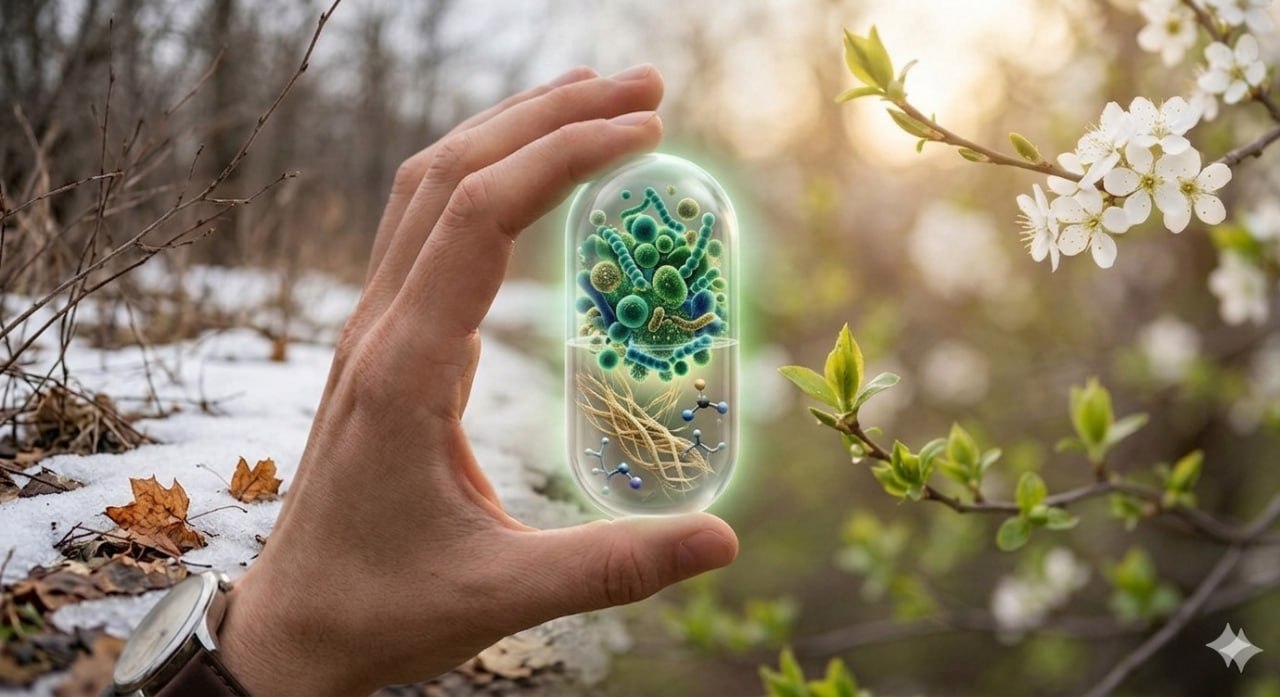
The beginning of spring. That season when the body runs on "leftovers."
Winter drained the batteries, there was almost no sun, and on the plate—scrawny greenhouse greens that look more like decoration than a source of energy.
The logical step is to go to the pharmacy for "vitamins for energy."
But there's a small nuance: vitamins don't work on their own. If the microbiome is in hibernation, even the most expensive complex can pass through you in transit.
Why our microbiome is more important now than a new bottle of pills.
Bacteria in the gut are not passengers, but a separate "microbial organ" that does what our own metabolism cannot.
🤩Your own "vitamin factory".
Bacteria produce B vitamins (B12, folic acid, riboflavin) and vitamin K, as well as other nutrients that we don't always get enough of from food. If the microbiota is depleted, this internal source simply doesn't work.
🤩Energy from fiber.
Bacteria ferment indigestible components (fiber), turning them into short-chain fatty acids (SCFAs), such as butyrate, acetate, and propionate. For intestinal cells, this is like a good, thoughtful breakfast, not a snack on the go. Fuel means focus and vigor.
🤩Support for immunity.
About 70% of all immune cells in the body are concentrated in the gut.
✔️Beneficial bacteria stimulate the production of immunoglobulins (especially IgA), which neutralize toxins and viruses.
✔️A properly formed microbiota from childhood reduces the risk of developing allergies, asthma, and autoimmune diseases.
Probiotics, prebiotics, metabiotics—what should you actually buy?
To avoid buying half the pharmacy, it's important to understand who is who:
Probiotics - live bacteria💊.
Needed when you want to "introduce" beneficial strains: after antibiotics, infections, severe stress.
Prebiotics - food for bacteria🍽.
Inulin, plant fiber, pectin. They help grow your own flora, unique as a fingerprint.
Synbiotics = probiotic + prebiotic in one capsule.
Conditionally: you landed a squad and immediately gave them rations.
Metabiotics / postbiotics - not the bacteria themselves, but their "finished products" or metabolites (e.g., the same short-chain fatty acids).
A good option if any live bacteria instantly cause bloating (a common story with SIBO).
How to understand that the problem is not "vitamins, but the microbiome?
You don't necessarily have to start with an expensive microbiome test. First, look at your feelings:
Reaction to food.
If even a careful portion of vegetables sharply bloats your stomach, this could be a sign of small intestinal bacterial overgrowth (SIBO). In such a situation, starting with powerful probiotics is like throwing wood into an already blazing fire. It's more logical to start with gentle metabiotics and work on your diet.
Skin and allergies.
Spring rashes, itching, "irritated" skin that cannot be explained by cosmetics alone are very often linked to the gut and impaired mucosal barrier. If externally everything is "for sensitive skin," but it still rebels, it's worth looking inside.
Where to start examination without fanaticism
A good starting point is a regular stool analysis🔎.
This is an inexpensive and fairly informative test that will show:
1️⃣how you digest fats, proteins, and carbohydrates;
2️⃣whether there are signs of inflammation;
3️⃣whether enzymes are doing their job.
Then you can add more complex studies if they are really needed.
And most importantly, the microbiome does not like sudden movements.
Sometimes it's better not to buy another "miracle probiotic," but to:
✔️add normal sources of fiber to your diet (vegetables, whole grains, legumes—as tolerated);
✔️give the bacteria at least a couple of weeks of stable routine before "introducing" new strains.
Our internal resource is not only vitamins in a bottle, but also those who live inside us and work 24/7.
And spring is also a good time to finally establish a relationship with them🤗.
@nastroi_zdorovie 🎧
Comments
0No comments yet.
Sign in to join the discussion.