
On Friday we discussed the flat map of PyPI. But today is April 12, so let's look at package managers on a cosmic scale.
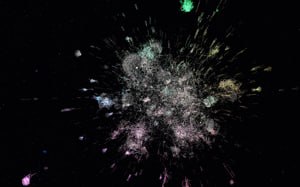
The Software Galaxies project presents various package managers (including PyPI) as a 3D galaxy 🌌
Galaxies are structured as follows:
✨Each point (star) is a package.
🌟The larger the star, the more other packages depend on it. The "heavyweights" of the ecosystem are immediately visible.
🕸Packages are not scattered randomly. The force graph tries to group together packages that are often used together or depend on each other. This creates "clusters" or "nebulae." Lines show direct dependencies.
If you turn on all dependency lines, you get a beautiful but completely unreadable "hairy monster" 🤯 (seriously, that's what the docs say!). So by default, only the shortest connections are visible—between closely located packages. But you can turn them all on (L key) if you want to be horrified admire.
The coolest part is the interactivity. You can literally fly through this 3D galaxy of packages:
On a computer: Mouse + keyboard (WASD + Q/E for strafe/rotation, R/F for ascent/descent, Shift for speed). The "follow cursor" mode (activated by spacebar) is especially recommended—it's like a spaceship! 🖱⌨️
On a smartphone: One finger to fly forward, two fingers to go backward, tilt the device to look around. 📱
You can find a specific package by name (regex supported). However, the authors honestly warn that on very large graphs (millions of packages), search may lag.
Happy holiday! Go out into outer space 👨💻
Comments
0No comments yet.
Sign in to join the discussion.