
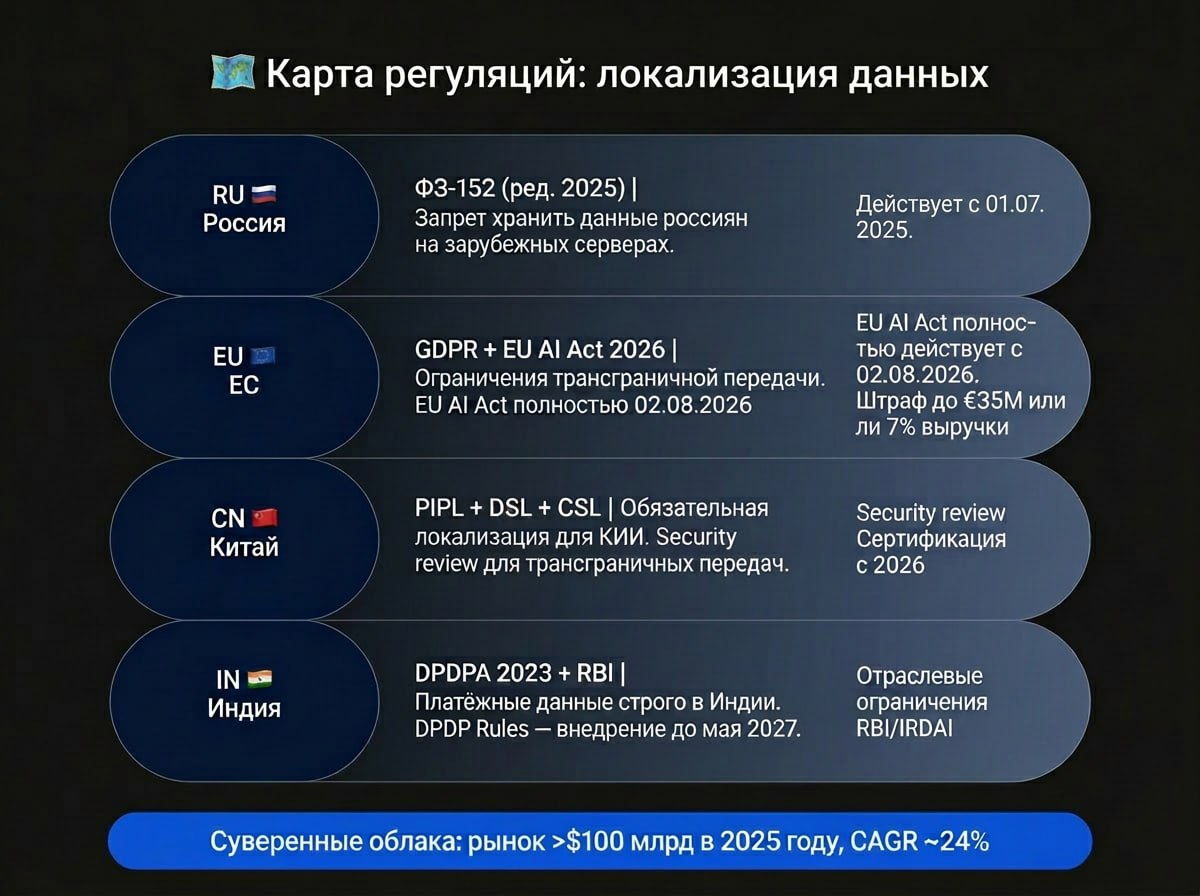
🔖 Sovereign Clouds and Data Localization: A New Reality for Business
⚡️ Your AI service makes an API call to a foreign cloud with Russian user data. This is already a violation.
Starting July 1, 2025, Russia imposes a direct ban on storing personal data of Russians on foreign servers — no longer an "obligation to use Russian databases," but an outright ban. Violate it — expect Roskomnadzor.
🏗 How to Build Architecture Considering Data Localization
Forget about a "single global infrastructure." Sovereign architecture is built on three principles:
1. Data zoning — each region gets an isolated stack (separate databases, models, logs)
2. Regional AI inference — LLM/ML models are called only within the user's jurisdiction
3. Federated identity — IAM does not cross borders without explicit consent
Cloud providers are already responding: Yandex Cloud, VK Cloud, SberCloud — for Russia; Gaia-X, OVHcloud — for the EU; Alibaba Cloud, Tencent Cloud — for China/APAC.
✅ Practical Steps Right Now
1. Data mapping — record where each category of user data is physically stored
2. Audit request routes — check all API calls: where does data go when accessing external AI services (OpenAI, Gemini, Anthropic)?
3. Choose a cloud provider — prioritize providers with FSTEC/FSB certification (Russia) or ISO 27701 + EU Cloud CoC (EU)
4. Legal matrix — create a table "jurisdiction → data type → allowed providers"
📊 The sovereign cloud market exceeded $100+ billion in 2025 and is growing at a CAGR of ~24%. The regulatory race only accelerates this growth — not because they "want to," but because they must.
💬 Have you encountered data localization requirements in your projects?
Share in the comments — how did you solve it? Did you choose a sovereign provider or build a hybrid?
#sovereigncloud #datalocalization #DataSovereignty #GDPR #FZ152 #PIPL #digitaltransformation #cloud #ITmanagement #ITransform
Comments
0No comments yet.
Sign in to join the discussion.