
MiniMax M3: 1M Context, Sparse Attention, and the End of Chinese Freebies ☹️
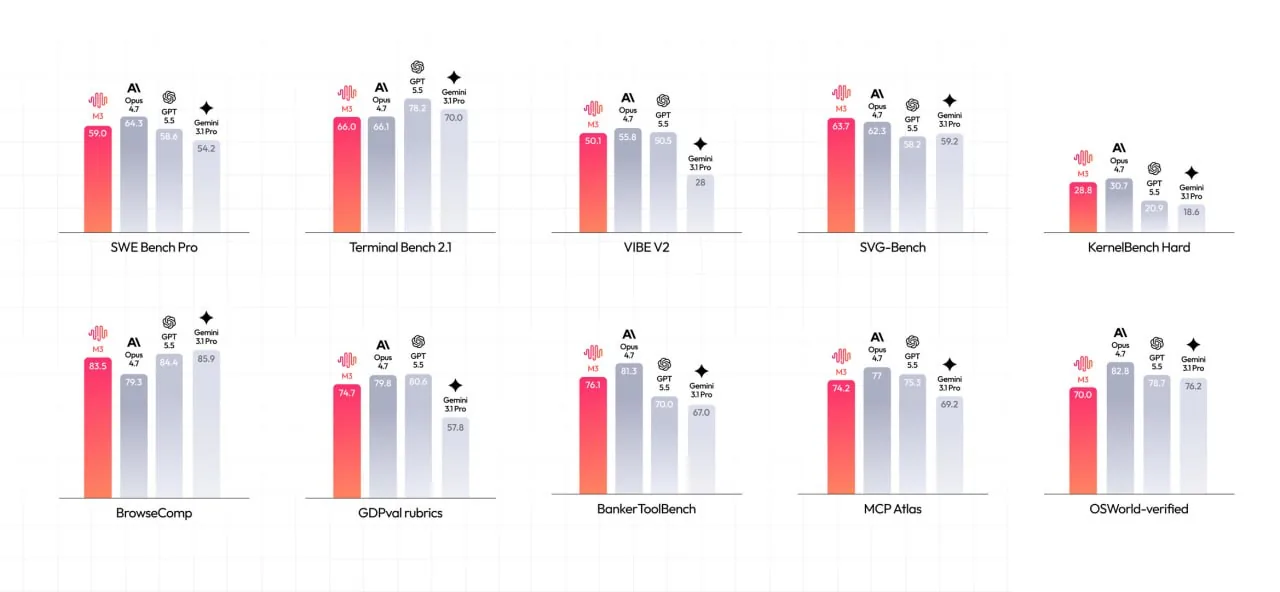
Released MiniMax M3. According to claimed benchmarks (SWE-Bench Pro 59.0%), they beat Gemini 3.1 Pro, GPT-5.5, and are breathing down Claude Opus 4.7's neck. But we all know the real value of synthetic benchmarks. Much more interesting is what's under the hood and how the developers decided to monetize this feast of intelligence.
Engineering-wise, they did a very cool thing — they aimed for a genuine and working 1M context. To avoid the quadratic complexity curse of classic attention, they introduced their own architecture — MSA (MiniMax Sparse Attention).
The essence is smart pre-filtering: KV is split into blocks, read exactly once, and memory is accessed continuously.
👉🏻 In practice, this means that on a 1M context, computation per token became 20 times cheaper than their previous model.
The second important point is the focus on long-term agentic tasks.
Most current coder tests are one-time boilerplate generation. MiniMax, however, trained the model on an interactive simulator of multi-step collaboration.
They made M3 optimize an FP8 GEMM CUDA kernel for the Hopper architecture. From scratch, no references, only documentation and a non-working skeleton. The model worked for a day, made 1959 tool calls, and went through many plateaus. Where other models (even the praised Opus) hit a wall and gave up, M3 kept finding new optimization paths and on the 145th attempt produced a result, raising hardware utilization from 7.6% to 71.3%. The model's ability to keep a huge log of logs, metrics, and failed code snippets in memory — that's where the 1M context really pays off.
Nice little touches: the "thinking" mode for complex tasks can be toggled on and off in the API without changing the pricing plan, and their desktop app MiniMax Code now natively supports multimodality and can share your computer (e.g., transfer data from Excel to ERP).
Now let's come back down to earth 🛬
I recently subscribed to their Token Plan. The main reason was that it was simply cheaper. In the subscription market, $10 plans have almost disappeared, but MiniMax had one, and for many everyday tasks it was more than enough.
But the laws of unit economics cannot be fooled. With the release of the new model, the ride of unprecedented generosity is over. The $10 plan was simply removed. Now the entry threshold is the classic $20 per month, and usage limits have become noticeably stricter.
First, we dump prices, feed the audience, and as soon as we release a truly competitive flagship model, we close the shop and start fleecing the user base. Eh.
Comments
0No comments yet.
Sign in to join the discussion.