
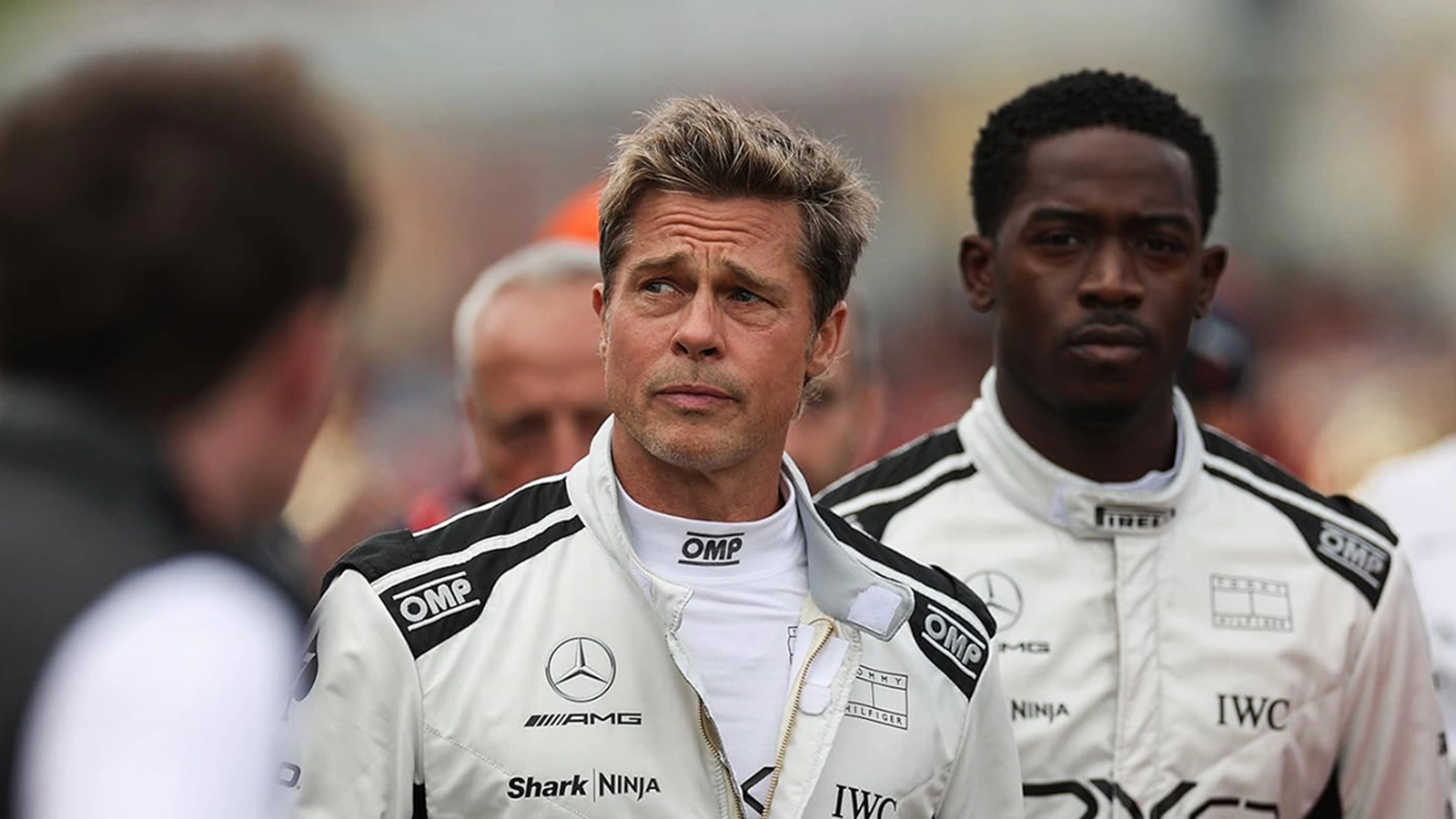
On June 27, Joseph Kosinski's sports drama "Formula 1" about a failed racer played by Brad Pitt hit global theaters. We tell you why the new Apple TV+ project makes viewers wince and endure.
Aging but masterful Formula 1 veteran Sonny Hayes (Brad Pitt) once showed great promise and dazzled fans with his dangerous, uncompromising driving style, but after a shocking crash, he was written off and sent to conquer less prestigious championships, and eventually to drive a taxi. Wasted dreams, three failed marriages, intervertebral plates to stabilize a broken spine, gambling addiction, and wild behavior—not the best prerequisites for a return to former glory, but a well-worn path for a cinematic “great” underdog.
And it doesn’t matter whether he’s a trendy racer, a skinny skier, or an outsider footballer. He’s always the underdog, the troublemaker, and a man of honor (he makes mistakes but doesn’t lie or betray). Sonny Hayes is exactly that—a protagonist axiom, a studio construct molded in Hollywood labs, perhaps ripped from the unconscious of the early 20th century. Thomas “Toodles” Waldron from 1919 is not much different from, say, James Hunt from 2013 or Toby Marshall from 2014.
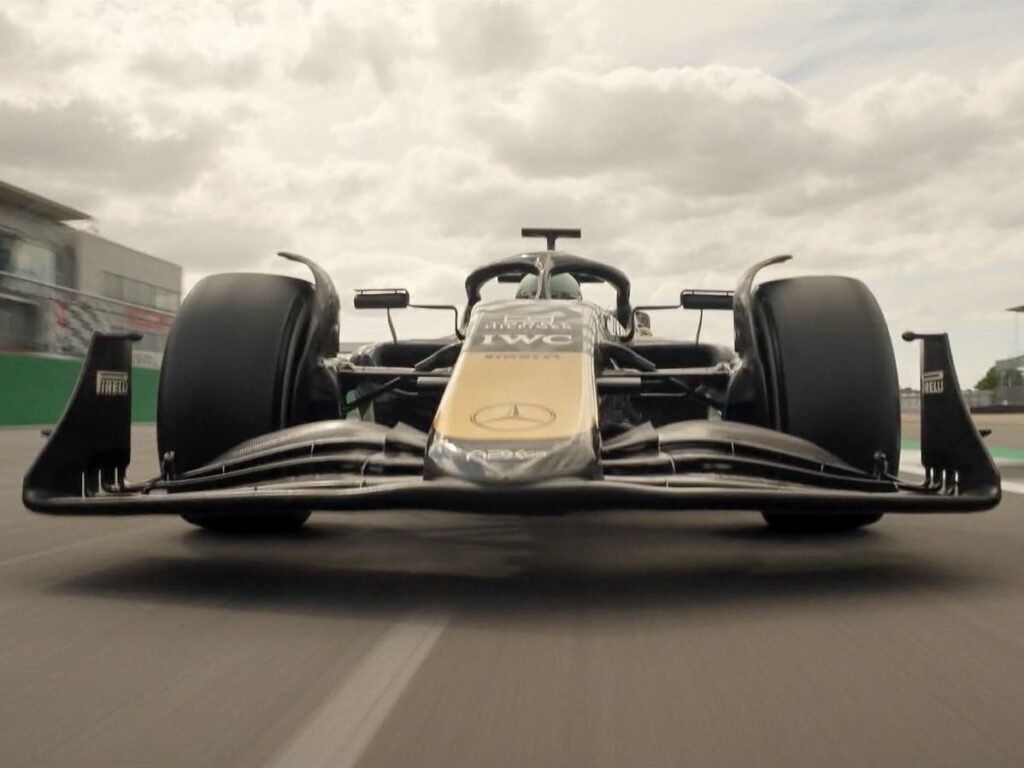
However, it leaves a few ascetic touches, emotional notches on the body of the cool loser Hayes: among other things, he is superstitious and has clearly experienced a family tragedy, as his desk photo with his father tries to convey.
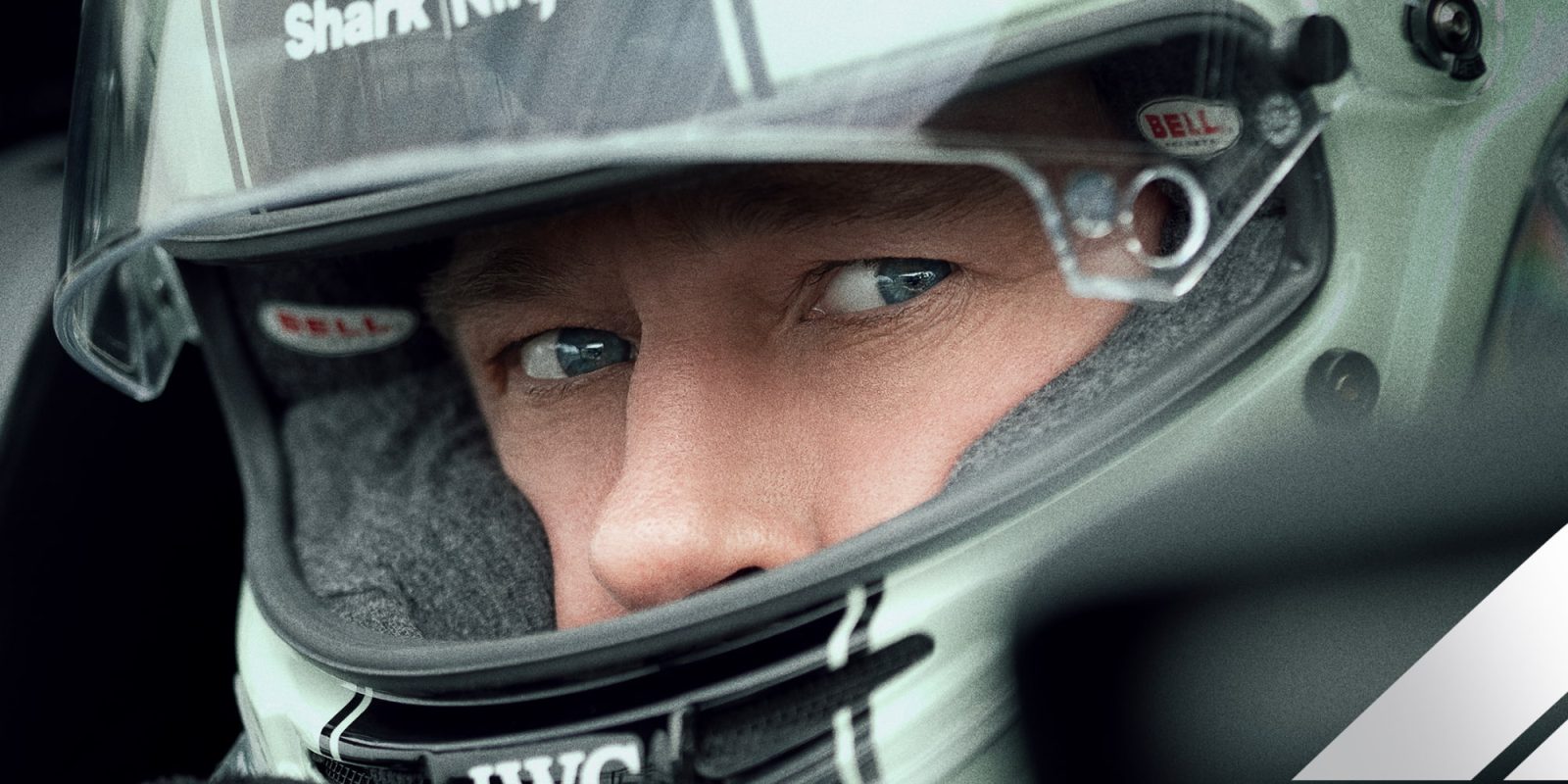
A parade of premieres from Netflix, including the return of "Happy Gilmore." Potentially the biggest blockbuster of the year from Apple TV+. Star-studded comedy action films from Amazon Prime Video. In our
Open materialBut surrogate similarity attracts another similarity. Alongside Sonny Hayes, marketers have inserted the hysterical accelerator Joshua Pearce (Damson Idris), the lovelorn romantic Ruben Cervantes (Javier Bardem), and the battle-hardened friend Kate McKenna (Kerry Condon). The latter even spurns market trends and the latest achievements of feminist film discourse, giving herself to Hayes after a successful poker hand because she “loves winners.” On one hand, it’s a bold and charmingly “ramming” flirtation with the audience; on the other, it’s an absurd and passive plot device. And this is a global problem with “Formula 1,” as the film literally forces the reviewer to speak about it either monosyllabically and unconstructively, or irritably and biasedly.
A Race to the Edge of Patience
The project by Joseph Kosinski loses points even where the monumental composer Hans Zimmer guards its position. His music implements a notable dual concept: Sonny Hayes and his car sound different. The former is given an orchestral score, the latter an electronic one. The hybrid “man inside the machine” plays loudly and expensively, but in an atmosphere of empty fanfare stagnation. Hans Zimmer and his team didn’t write music; they shamelessly copied the substantive basis of previously released material.
The hit songs of days past also feel clunky and indigestible. In the presence of young Joshua Pearce, the bird trill and cold clatter of a mountain stream fall silent, and tropical house from the mid-2010s or now-wrinkled trap begins to play. And it’s understandable: after Sorry and I Get the Bag, “it’s impossible to write poetry.”
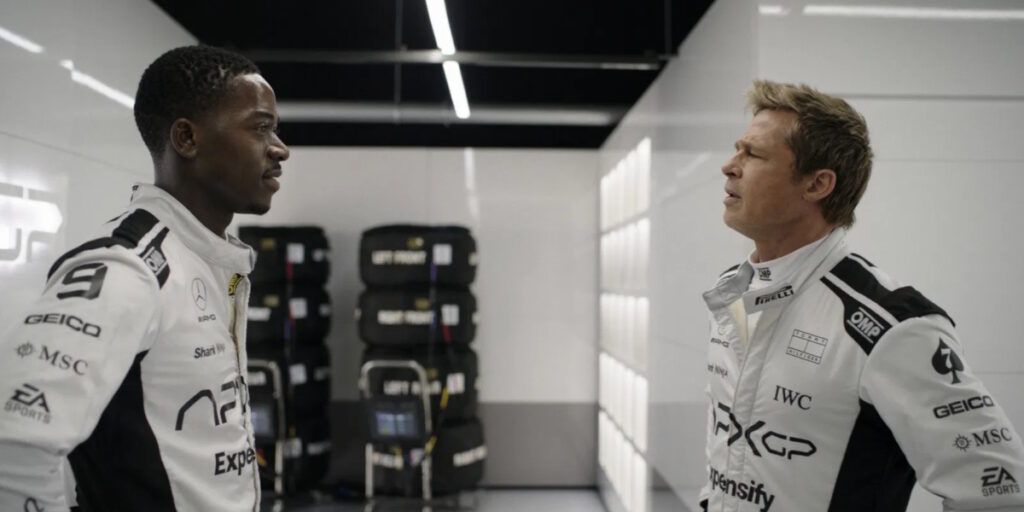
At this point, it would be permissible to bid farewell to “Formula 1” and brand it an anti-humanistic and vulgar spectacle, but we must not forget the two pillars of this new film—the races and Brad Pitt.
There was never any doubt about the latter. Despite his comedic-sardonic career trajectory, for $30 million the actor can forget the pleasure derived from roles as charming idiots, like Jack Trainer in “The Lost City” or Chad (also a trainer) in “Burn After Reading.” “Formula 1” once again pulls from the closet the quintessential man, rebel, and seducer—a banal but devilishly successful maneuver.
If the film needs to feed another truism, vulgarity, or stupid joke, it does so through the eyes, expressions, and charisma of its main star, and suddenly you’re not angry but smiling and suppressing a shameful chuckle. With the smile comes the realization that only “Jupiter” is allowed to save films with his presence and drive forward the scattered “bulls.” Fortunately, Brad Pitt is not alone in his rescue mission: he has the car, Kosinski’s action direction, and maximum access to F1’s infrastructure and inner workings (no wonder the film is produced by Lewis Hamilton).
Cinema in Black and White Checkers
The production team of “Formula 1” certainly tries to latch onto any genre standards and formulas. Thus, Sonny Hayes leaves and returns twice at the very last moment, gets into two serious accidents, and witnesses one (Joshua crashes and gets burned). There are also training montages set to lively rhythmic music, confrontations with journalists, and conflicts with the young teammate. But the dramaturgy here, unlike in “Ted Lasso” or “Moneyball,” concerns the creators and audience little. The anchor becomes the multiple races, their pace, and creative execution.
The action in “Formula 1” is not only about sporting character and high stakes but also about the mechanics and principles of organizing each qualifying session and Grand Prix. Perhaps for the first time, cinema speaks of F1 not as a philosophical fairy tale about a superman but as a sporting competition. That is why Sonny Hayes and the APEX team did not win the main prize but only claimed victory on one track. The film is dedicated not to their victory but to the multifaceted nature of the planet’s premier circuit championship. Like football offsides, formations, and false nines, F1 has virtual safety cars, red flags, multiple tire compounds, turbulence, and regulation by a multi-page rulebook. And Sonny Hayes is the perfect guide in this world because, resisting, he loves to find imperfections in the system and ways to demonstrate its absurdity.

Each new track in “Formula 1” is a tactical game, an exercise in ingenuity and situational awareness, like chess puzzles or Fischer random chess. Brad Pitt’s character doesn’t just drive and compete; he solves a contextual puzzle. Sometimes this leads to situations that are hard to imagine, which outraged professional audiences, but a film with a budget of hundreds of millions shouldn’t have to satisfy the demands of niche geeks.
It’s not the lack of realism that undermines interest in the film, but the deep ignorance of the script and the primitive dialogue to which Kosinski subjects the viewer. The question is only how much one needs to abstract from all the above so that the races and Brad Pitt take the microphone from the voiceless narrative. As a result, “Formula 1” turned out to be a borderline project with an original approach to sports competitions but a bland, droning narrative. Yet there is a certain charm in watching the antics of a heavy, clumsy blockbuster that can not only rake in great box office but also inadvertently provoke indignation from racers, critics, and the left-wing press alike. Truly a landmark project.
Trailer:
Comments
0No comments yet.
Sign in to join the discussion.