
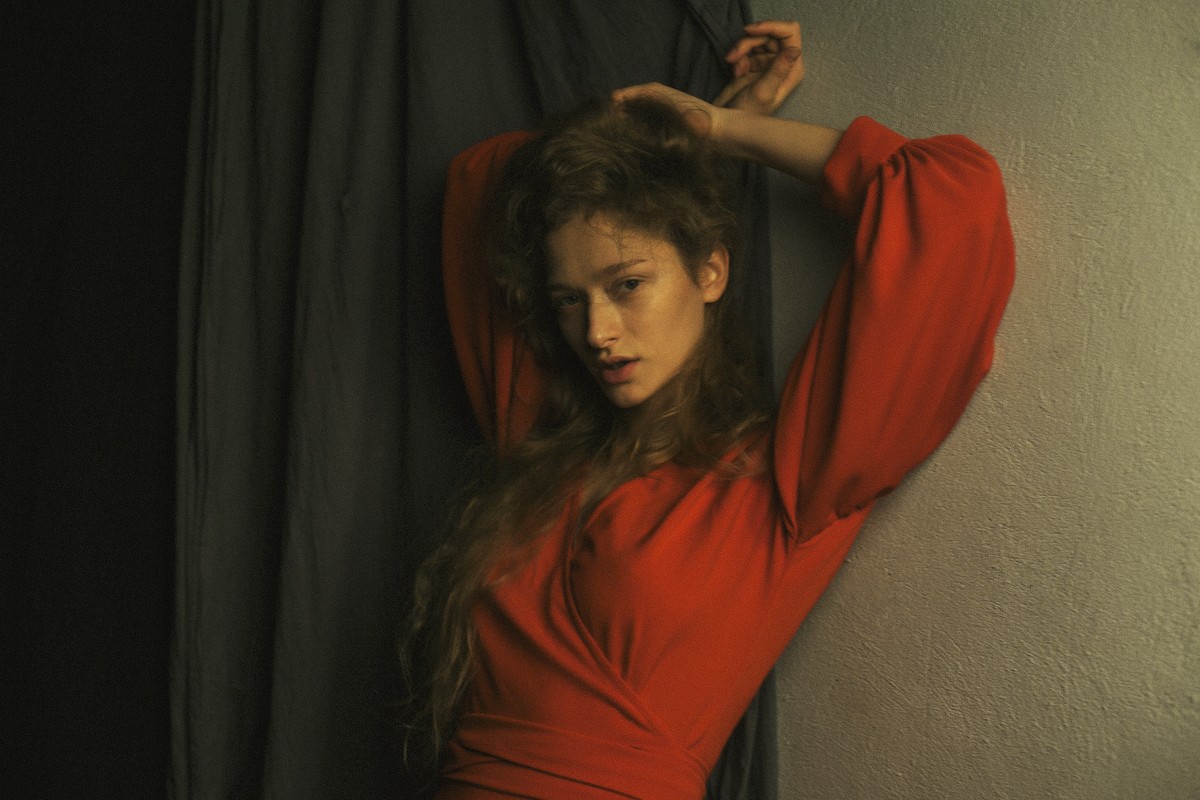
On December 20, the series "Molodezhka. Novaya Smena" was renewed for a second season. One of the main roles in it was played by Diana Milyutina, star of the series "Chistye" and "Fisher." We talked with the actress about her creative path, her roles...
In summer, the series "Chistye" by Nikolay Khomeriki, an outstanding independent director, made a sensational bold statement, and in November, "Molodezhka. Novaya Smena", a sequel to one of the cult series of the 2010s, was shown with great success on STS and has already been renewed. In both projects, one of the main roles was played by Diana Milyutina, a rising star of Russian cinema. We discussed with the actress her best roles, profession, and dreams.
– Do you feel a wave of success after the series "Chistye"?
I would say it's a big wave that started with "Fisher." I had a small but very important role there, and many people in the profession told me I played it well. Then, naturally, there was "Chistye," and now "Molodezhka" has come out.
But for me, it's not that important. I'm an athlete, a perfectionist, I don't pay attention to it. What matters to me is not so much the number of subscribers, but the feedback from people in the profession about my roles, about my performances. But the main thing is not to dwell on that and to move forward even after successful roles.
– In one interview, you said that when you go to audition for acting, you can't separate the love of art from the love of seeing your face on billboards. Is it easier for you now to separate these things, or does one help the other?
Seeing my face on billboards gives me a certain inner strength, it fuels me just like the feedback from my subscribers and fans who come to the theater after watching some series with me. It boosts my inner confidence, making it easier to go to auditions.
– How has your attitude towards choosing roles changed, given that there are more and more offers?
First of all, it's become harder to choose. My time is not elastic, and I can either spend four months on one major role or manage to play five small roles in that time. Naturally, I have to base it on how interesting the role is. If nothing particularly happens to the character, she doesn't develop, I won't find it interesting to play. But if even small roles are meaningful, like in "Fisher," I'd rather spend time on them. Because of the large amount of work, I realize that health, unfortunately, is also not elastic. You can't earn all the money, as a colleague of mine in the theater said, looking at my dark circles, and sometimes you have to refuse some passing roles. Now I try to set priorities wisely.
– Given that you really can't earn all the money, when choosing a new project, say, between a new independent film by Nikolay Khomeriki and something obviously more commercial and popular, what would you choose?
After Nikolay's project came "Molodezhka," and I managed to combine independent and popular. Both are important, but at this stage, I would probably choose the auteur. If a director of that caliber trusts me with a role, that in itself says a lot. And, of course, returning to the previous question: the role matters. Recently, I turned down one project in favor of another with half the fee. The role in the new project was interesting to me, and I generally wanted to play something like that, although, of course, there is always a risk that everything will turn out somewhat differently than expected.
I don't chase fees and the most popular projects: sometimes being everywhere means boring the audience. But one can help the other, and popular series actually draw attention to independent ones: many subscribers who appeared thanks to "Molodezhka" are now watching "Chistye" and are surprised.
I think it's right that there is something to be surprised about: when you flow from project to project unchanged, everyone gets tired, including you. It's important for me to find roles that are different from each other. And female roles (and this is a blessing) can be very diverse. After "Chistye," I was afraid that I would only be offered roles of beauties or escorts. But that's not the case, and so far I've been getting completely diverse roles.
– Does Russian cinema offer enough truly different female roles, complex characters? Is there a role you would like to play but no one has offered?
There are roles I want to play, but they haven't been offered yet due to lack of material. However, in many scripts I receive, the heroines are actually very diverse, and there is something to play. It's just important that the actress herself has the desire, that it's interesting.
– Regarding "Chistye." Everyone asks you about the nude scenes, but there were probably much more complex and interesting moments in the role.
Of course. Everyone focused on that, but the series has things much more difficult than nudity. There was something to play. Nudity is just an element of the heroines' profession. For them, it's not an event, but a part of life. At the same time, my heroine goes through illness, persecution from, let's say, colleagues. All of that was much harder and more interesting to play. The sex scenes, contrary to perhaps expectations, turned out very beautiful and quite pure, so to speak (a play on words, referring to the series title and clarifying its subtext). Ultimately, this is a series about how a person is not reduced to their environment; what matters is not what's around, but what you are like.
– You once said that playing an unattractive, ugly heroine is such an interesting challenge. If a role required you to change your appearance, would you agree? How serious a transformation are you ready to undergo?
From the obvious: for example, I was ready to dye my hair black for a role. However, I understand that more roles with light hair are offered now, and it's not such an easy choice. I'm ready to shave my head. Hair will grow back better (laughs), and the shape of my head allows it—I have a beautiful skull. I'm also very interested myself, I want to see myself with short hair. But if I were offered, like Alexandra Bortich for "I'm Losing Weight," to gain weight, I would most likely refuse. That's a heavy strain on the body.
– Your most recent project is "Molodezhka. Novaya Smena." You said you didn't watch the original series when it came out. Did you watch it for the role?
No, because I didn't have time. After "Chistye," "Molodezhka" started immediately. The problem is also that each season has 40-50 episodes, not like ours (in "Molodezhka. Novaya Smena")—16. Watching 6 such seasons is probably too much, so I sometimes just watch scenes, see what our adult actors were like 10 years ago, what love lines there were. It's interesting to see how the picture changes. So, yes, I watched some of it.
– Was it difficult to integrate into the established cast? Although it's a sequel and, as I understand, not everyone is the same.
Yes, we have many new people, so it wasn't difficult. I wouldn't say it was hard, but I did integrate into a really tight-knit cast in the third season of "Ekaterina." Over two seasons, everyone had already worked together: Marina Alexandrova, Pasha Tabakov, the whole company. But I integrated perfectly and quickly: it all depends on the team, on the actors who accept you into the team, into the family in a sense.
– I think I saw that series on TV. Then, watching "Chistye," I couldn't figure out why your face was familiar.
When we were filming "Chistye," Fyodor Sergeevich Bondarchuk told me a similar story. How he came to the hotel after filming, turned on the TV, and there I was again, only in the 18th century.
– Was that in "Ekaterina" where you were languishing in Italy waiting for the throne?
No! There are two series about Catherine. "Ekaterina", where I am a lady-in-waiting to the wife of Paul the First and his favorite, Ekaterina Nelidova. And the second series, where I am Tarakanova, is "Velikaya". That series was directed by Sergey Vladimirovich Ginzburg. There I was in Italy, and not only.
– Did you learn a lot about the era?
Yes, it's two seasons of one series and another season of "Velikaya"—quite a lot about one time period. I fell in love with that era. Although I would like to dig even deeper into history—say, I would gladly star in a film about Vikings. As well as about the USSR. It's interesting to delve into because, by immersing yourself deeper into the past, you ultimately better understand that in such different eras, there are the same problems, concerns, desires.
– If you like acting in historical films, you probably like watching them too?
Yes, I watch a lot of them, although it's always hard to pick favorite films and series. It's like with idols: I have no idols I look up to, and similarly, I can't choose films that I would call "favorites" on occasion. I like very different movies, but as soon as I'm asked, I forget them, and my mind goes blank. However, "The Favourite" immediately comes to mind, an excellent film. And "Versailles" is a good French historical series.
– After "Chistye," also a historical series, you radically switched to "Molodezhka," a sports drama. What is your relationship with sports films in general?
I love sports dramas. I did sports myself, and this topic interests me. Although, of course, sometimes it's hard to watch: I always notice the deception. I see, for example, a cut from the main character's face to her legs and understand that those are not her legs, that the movements are performed by a stunt double. Also, empty stands in movies bother me—competitions can't take place with empty stands. In short, many things trigger me, but still, I really love sports films. From "Legend No. 17" to "I, Tonya," an outstanding film with Margot Robbie. So I watched all episodes of "Novaya Smena" with pleasure. It was amazing how our boys looked great in uniform. The action during the matches is truly captivating.
– Speaking of Margot Robbie. As is known, everyone talks about how actress Emma Mackey resembles her. About you, one can find online that you somewhat resemble Svetlana Khodchenkova (the interviewer forgot the comparison with the film "The Substance" and now regrets it).
Oh yes! Since I entered the Shchukin Academy, I've been constantly compared to her. It all started when someone said, "Oh! Young Khodchenkova." That stuck pretty quickly. And only later, during the filming of the fourth season of "Ekaterina," people started telling me that I'm not Khodchenkova, but Margarita Terekhova. That's nice, of course. In institute productions, I played Milady (Terekhova's most famous role). And in principle, that's probably a dream role for me. Tarakanova, my heroine in "Ekaterina," is somewhat similar to Milady. They are both adventuresses.
– Do the comparisons annoy you?
How could that annoy me? Svetlana is a wonderful actress. Beautiful. Striking. That comparison is actually a compliment. Moreover, we certainly play differently, our nature is different. It's just that people are not very attentive, and there is probably an external resemblance, but many people have doubles, they just don't know about it.
– Maybe you were ever offered to use that. Play a daughter, perhaps?
No, but I was offered to be a double. I was very busy in the theater at the time and went to an older colleague for advice. He said not to agree: "You're not only not as an actress, but they also pay little." So I didn't use my external resemblance.
– What seems most important to you in your profession now? How would you articulate what you consider important in acting? Has anything changed?
Earlier, I was always chasing work. I thought I should never stop, always be in the process. Indeed, I would finish one shoot and immediately jump into another, participating in parallel projects. Now I see the amount of work I've done, remember my roles, and think about how lucky I am that there are none I would want to erase from my filmography. Now I would like to take not the quantity of roles, but their significance, depth. I would like, so to speak, to bathe in each of my roles.
Actually, it's hard for me to evaluate myself—I can't see myself on screen. It was the same before, when I was doing ballroom dancing. I couldn't watch myself after competitions. I didn't understand why we got first place, because it seemed like everything was so bad. Only later, after some time, did I realize that there was something to it. With cinema, I also need some time to pass so I can look back at my filmography. I would like it to consist of works for which I will be thanked.
– Is feedback important?
Of course. I believe an actor without feedback does not exist. Just like an actor in the theater—we are nobody without the audience. For whom do we do this then?
– Is the opinion of critics as important to you as that of the audience?
Of course. I immediately encountered the attention of critics in the theater, because I quickly got big roles, and it was an important, formative experience. Especially reading reviews from authoritative critics. Equally important, by the way, is the opinion of colleagues. Especially older ones, from whom I learn, whose work I admire. Their criticism is important. Simply, unlike colleagues and journalists, audience assessments are not always sober. Some people look not at your work, but at your face and figure. And an actress is more than just appearance, which many forget.
– You talk a lot about colleagues whose opinion matters to you. Are they only from the theater?
Of course, from the theater, but also from cinema. Those we met in different projects, worked together. Some of us are still friends to this day. This includes my classmate, with whom we studied together: she watches my broadcasts, although she is also very busy, and I always appreciate her feedback, as well as the feedback of other colleagues and friends. I also always try not to miss their work. Among other things, we learn from each other that way.
– Have you watched "Anora" with Mark Eydelshteyn (Diana's colleague from "Chistye")?
Not yet. But I saw on some social media how he takes photos with Timothée Chalamet. I will definitely watch the movie.
– What films that you saw this year would you highlight as favorites?
Recently I watched the film "Prishelets" with Maxim Stoyanov by Ivan Sosnin. It really touched me, it's good cinema. There were a few other films that I wanted to erase from memory and rewatch. That's just from the new ones. What I watched at the beginning of the year is already quite hard to remember.
– And series?
I watch a lot of what comes out. Recently I watched the first two episodes of the series "Mamonty." The plot centers on how scammers scam pensioners. A relevant topic, needless to say! And what an acting ensemble (and Yuri Stoyanov, of course!), how they play. Also, I only watched "Squid Game" this year. What can I say: I wouldn't show that to children. Even I found it creepy sometimes.
– I haven't seen it. It was too hyped.
Yes, I thought so too at first, but I still watched it to stay informed (and the second season is coming soon), and in the end, it's quite gripping. But we couldn't make something like that here, naturally, although maybe I'd like to—I haven't had any thrillers, let alone horrors, yet.
– Would you like to become a "scream queen" (as the main heroines in horror films are called. The term originated in the 1930s as a designation for Fay Wray's role in the original "King Kong," gained popularity and modern meaning in the late seventies)? Run from a maniac, scream, something.
I am, of course, a deeply dramatic actress (laughs), but I'm afraid it would turn out very comedic. If it were not in a horror, but in a black comedy, then I would like it. And you can even run from a maniac. But we lack them (black comedies, not maniacs) for obvious reasons. Moreover, it's a wonderful genre, it's always very funny. I love black humor, which, however, sometimes plays a cruel joke on me.
– Is there a director you haven't worked with but would immediately agree to collaborate with if they contacted you?
First of all, it's important that our visions align. However, there is always the danger that, perhaps, I've heard about a director and want to work with them, but then I come to the set and we don't get along at all, our views on the heroine differ. In that sense, I'd rather go work with those I already know, with "my" directors.
– When you choose projects, do you pay attention to how similar your heroine is to you? Could you play a person who is completely opposite to you?
Yes, of course. I even periodically choose heroines close to me in projects, but I get cast, on the contrary, for roles further from me. In February, a feature film should come out. I wanted to play a certain heroine, but the director suggested I also audition for a second role—a character somewhat further from me. And I was cast exactly for that role. Playing characters unlike you, more distant from you, is harder but more interesting.
The most vivid experience: filming in "Pervokursnitsy," where I played the heroine in her youth. It was really difficult—to get into that image, to understand it. On set, I had to immerse myself, to be unlike myself.
In general, if there is a distance between you and the heroine, you see the funny in her better. This is important for comedies, for example. In theater, some detachment helps a lot. When I first started playing Shakespeare's "Twelfth Night" at the Lensoviet Theater in St. Petersburg, I couldn't approach the role of Olivia, trying to find some drama in her. Then the director advised, on the contrary, to play with the role, to have fun, to see the comedic situation from a distance. Now I am grateful to the director for insisting on his vision, and I really love this performance; it turns out very funny—not only for me, of course, but also for the audience.
– In drama, such a distance is probably harder to maintain.
I don't know if it's needed there. For me, dramatic roles differ in the attempt to let everything that happens to the heroine pass through yourself, to try on her life. And so far, I haven't strayed too far from my real self in these roles.
– Given your role in "Twelfth Night," I think I can ask an old-fashioned question: a dream Shakespearean role?
From Shakespeare, who I would like to play is Katharina from "The Taming of the Shrew." And definitely not Juliet.
– You said in an interview that during your studies, you were annoyed by stereotypes that it's easy to study acting. Are there any stereotypes that annoy you now?
Yes. That acting is a very easy profession, that actors undeservedly receive fees. Although it's a myth that actors earn a lot in theater. In reality, it's money comparable to a doctor's or teacher's salary. Theater for actors is a pursuit for the soul. With cinema, it's a different situation. However, it's worth considering that becoming famous through cinema, an actor cannot afford many things. All this, not to mention the difficulties on set: we freeze, lack sleep, shifts sometimes last more than 12 hours, and you are in every scene and don't have time to go to the toilet, drink tea, or lie down.
– It's probably emotionally difficult too—getting into character, coming out of character?
Well, getting into character is always hard, but in theater there is time for rehearsals. At first, you don't know what to do with it, but with the director, partner, you all stew in it. It's a gradual process. In cinema, it's different: there's no time for gradual character development. It's a bit more difficult, in a way. Although, of course, it all depends on the role.
Coming out of character is easier for me. I know an actor who is always in some role in life. For me, that's, how to say it, cringe. I think you need to remain an adequate person and not associate yourself with your acting successes. It's just a profession. And after work, I'll come home and be Diana at home. Wash dishes, play with the dog, be a person, in general. I haven't had problems with that. So far. Who knows later, of course.
Comments
0No comments yet.
Sign in to join the discussion.