

Ryusuke Hamaguchi wanted to make something like a music video to the music of his friend-composer Eiko Ishibashi, but ended up making a ninety-minute parable about man and nature. Why this is the best film in theaters—in our review.
Takumi (Hitoshi Omika) lives with his daughter in a remote village. He is the son of post-war settlers who settled there, near the forest, deer, and an extensive system of springs. The latter is now under threat, as capitalists want to disturb the village's peace. A casting agency, taking advantage of COVID subsidies, plans to build a glamping (glamorous camping!) site in the forest, which will likely disrupt the local ecosystem. The problem is that the capitalists are in a hurry to secure government grants and are not too concerned about nature. According to their plans, wastewater will be discharged directly into the springs—unique water bodies that are a source of local pride.
At the meeting, the agency representatives look down on the villagers, who in turn are openly hostile to the newcomers. Their dispute, reminiscent of a similar meeting in the recent good Romanian film 'MRI', shows both sides that they cannot reach an agreement. The villagers are clearly in the right: nature will suffer, their accustomed life will be disrupted, and all this just because specific capitalists want to profit from government funding.
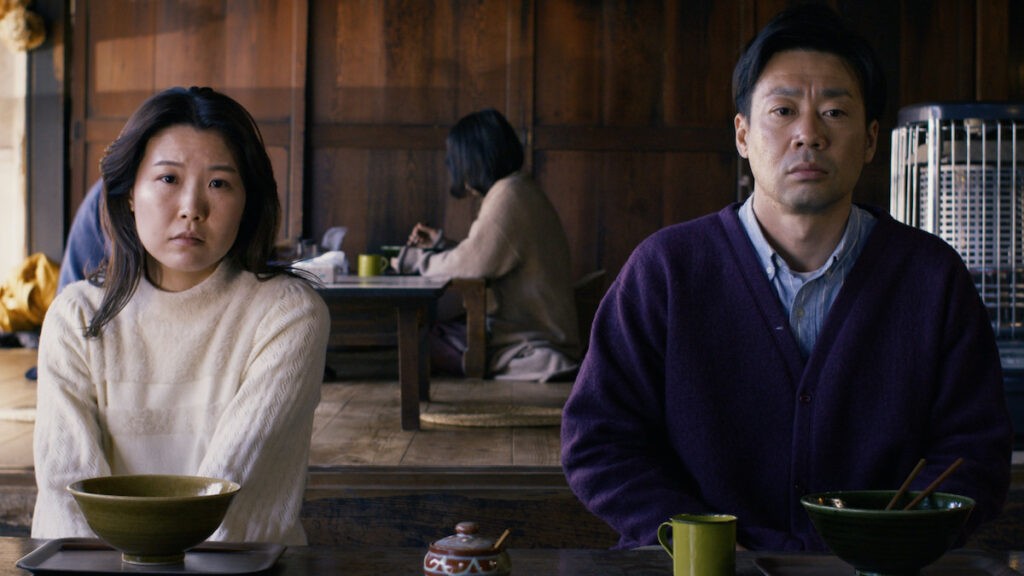
The agency's envoys, however, turn out to be quite likable people, detached from their profession. Mayuzumi (Ayaka Shibutani) used to work as a caregiver and entered show business due to a childhood dream, not for selfish reasons. Her colleague Takahashi (Ryuji Kosaka) is sometimes dismissive, sometimes rude, but generally kind. He wants to leave the agency and live a quiet, family life. In a better world, he would have become a guard at the very glamping site he came to promote. And when they are sent to the village again—to appease the locals while refusing to change the deadlines (which would be necessary to redesign the construction plan, but then the subsidy period would expire)—Takahashi imposes himself on Takumi as a companion. He talks about his love for nature, his dreams, his fatigue with city life, and how much he enjoyed chopping wood.
Takumi agrees to spend a day with the city folk and, naturally, later regrets it. And how could he not regret it: his protégé in forestry can tire anyone out even at the synopsis level, and his colleague, though sweet, doesn't fully understand what she wants. What Takumi wants, in turn, we don't understand. To be left alone, perhaps. The villagers' needs are most obvious against this backdrop: as residents of a village along a river, they have an obligation to the villages downstream to keep the water clean. Otherwise, due to the weakness of a specific community, everyone will suffer. This, of course, cannot be allowed.
'Evil Does Not Exist' belongs to that category of films that are difficult to discuss substantively without spoiling the ending. This is unexpected for such an idyllic picture, a third of which is devoted to walks in the forest accompanied by music by Eiko Ishibashi, but it is true. It's as if 'Walden, or Life in the Woods' were adapted by David Fincher. Still, we condemn spoilers, so let's try to offer a general framework for discussion.
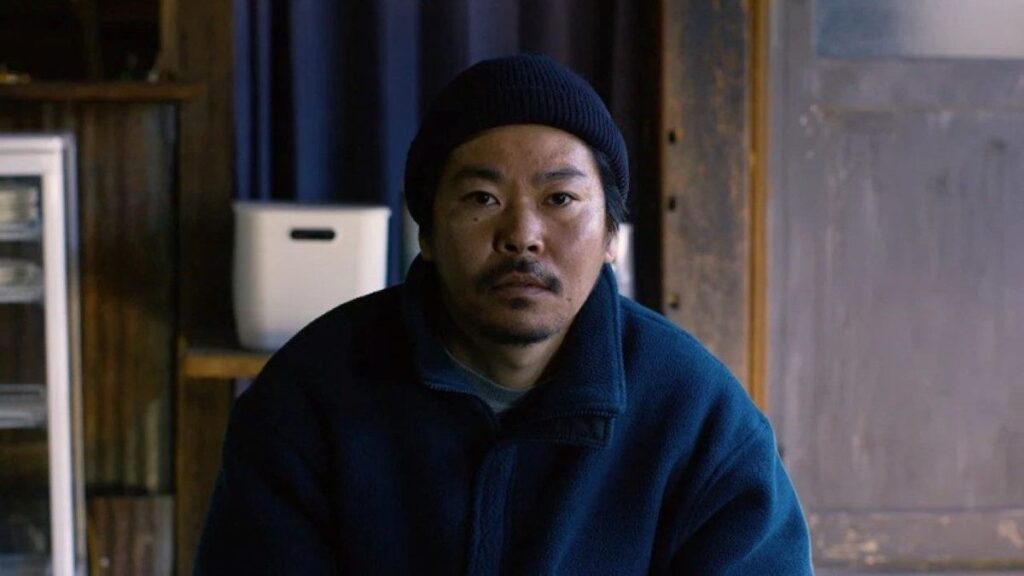
Ryusuke Hamaguchi constructs in 'Evil Does Not Exist' portraits of three worlds: late capitalism, nature, and the village community. Clearly, his sympathies are not with the profit-seekers: the director understood Chekhov too well in his time, and all the capitalists in the film are a fairly obvious collective Lopakhin. However, the choice between nature and community is not so obvious. Takumi is placed somewhere between them: he supports the needs of his neighbors, participates in village meetings, but the preservation of deer concerns him no less than his obligations to the villages downstream. Everyone in the village sees him as the chief forester, a man who knows the entire area and is very close to nature.
Nature is primarily demonstrated through the deer plot—peaceful and kind creatures that can kill if they feel danger and cannot flee. Deer need no excuses; they understandably have no ethical categories. Humans, however, need excuses, and so when the casting agency employees feel the moral rightness of the villagers, they try to distance themselves from their bosses—people as ruthless as nature, but who, unlike forest dwellers, can be blamed for it.
The communal life of the village turns out to be the only intermediate stage between these two extremes—the natural state and the city (capitalism). A cruel world where everything happens simply because it has always been that way (danger, instincts, deer beyond good and evil), and a no less cruel world that can no longer be justified so easily. The world of the city, unlike nature, is a world where there is freedom of choice. A world where everything could have been different but turned out this way. The community is also the result of free choice, but a more conscious, kinder one. However, such a life is a difficult path: the villagers are dependent on nature and vulnerable to city folk who can come at any moment and destroy everything. The rural idyll is fragile and unreliable.

All the characters have to choose how to live, and in this thought, perhaps, lies the entire pathos of director Hamaguchi. For him, man is ethical; the very acquaintance with the categories of morality makes an individual return to nature with its predetermination and instincts impossible. A deer cannot be blamed for anything, but a human can. However, the 'right' life is too complex and vulnerable. It is much easier to build a society according to natural laws (a kind of social Darwinism, so beloved by the right), but this is also not a very successful way out. Not just because it is hardly morally good, but also because the representatives of the casting agency want to escape from there at the first opportunity.
From the same plot, completely different conclusions could be drawn if director Hamaguchi did not believe in people and their moral nature. As the great singer of natural cruelty Werner Herzog, a furious and melancholic director whose 'Aguirre, the Wrath of God' could, for example, be watched as a double feature with 'Evil Does Not Exist', does not believe in them. If Hamaguchi were Herzog, it would be a completely different film. But the Japanese man believes, and this is a worthy choice, even if it leaves the director no chance for a different ending and simpler pictures.
As an honest author and an honest fan of Chekhov, Hamaguchi once again shows that the world is generally bad, but each individual has a chance to do good. Trying to return to a natural idyll is futile. Living in a society by the right of the strong is too simple and quite disgusting. The tragedy of man in this sense is precisely that he is human, he can reflect on his choice, and for him, evil does exist. And one must somehow live with this.
Comments
0No comments yet.
Sign in to join the discussion.