
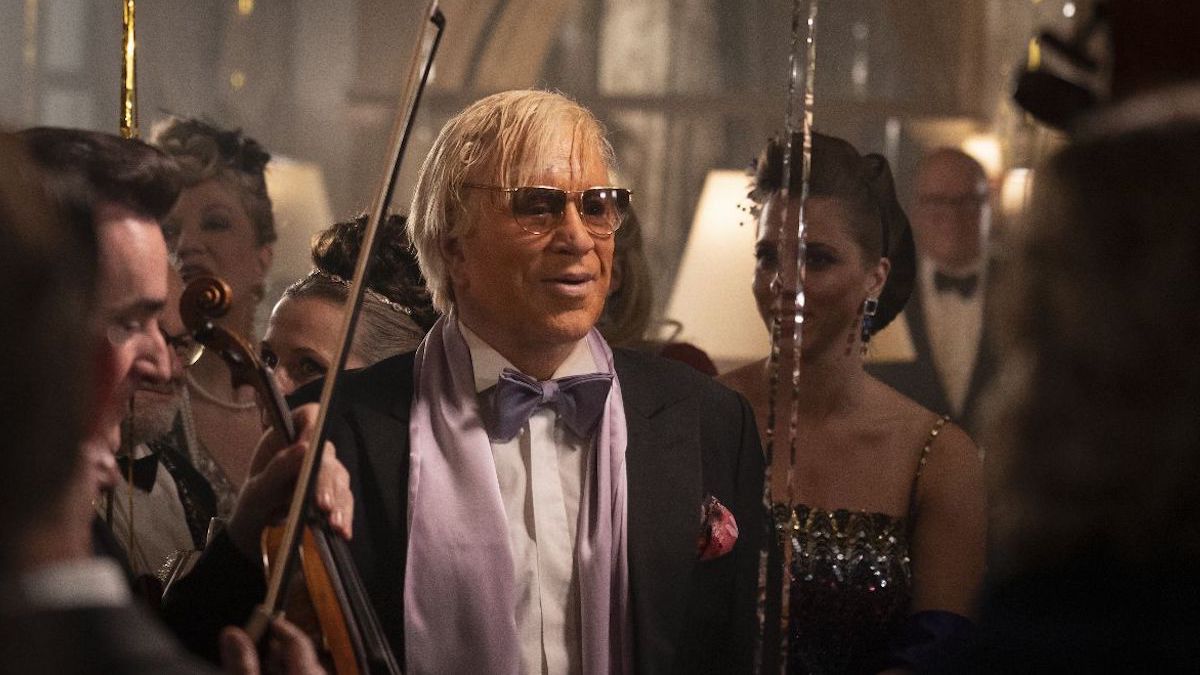
'The Palace', a dubious New Year's comedy about a failed apocalypse with cult potential, is being released. Our review covers how Polanski reimagined his early film 'The Fearless Vampire Killers' in the spirit of 'Peculiarities of the National Hunt'.
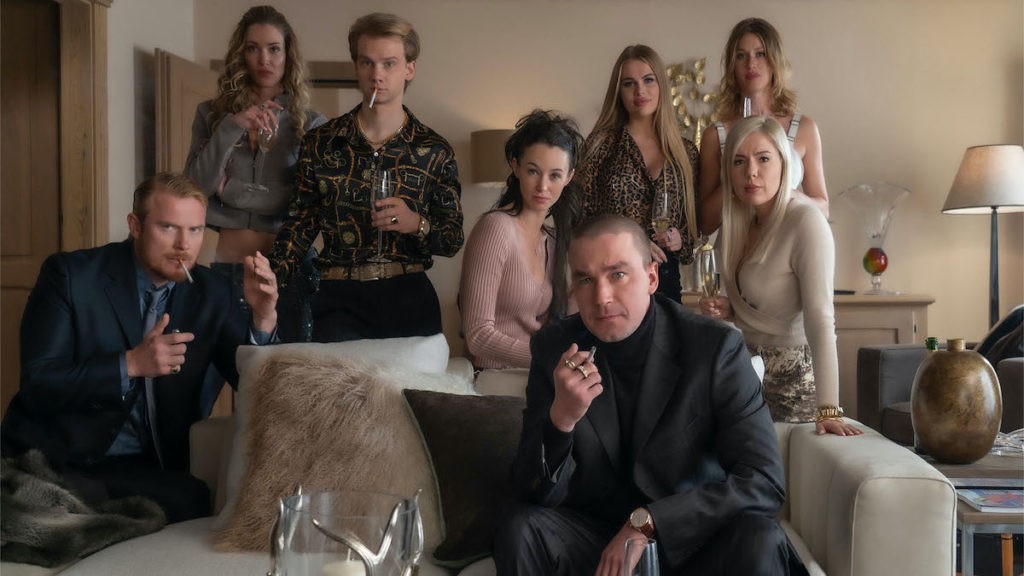
In winter, very wealthy people gather at a luxury hotel in the Alps. They meet there every year, but in 1999, everything goes wrong. Perhaps it was inevitable: power is changing in Russia, and now ambassadors fraternize with gangsters at the hotel. A nearly centenarian billionaire (John Cleese, wonderful) arrives to celebrate his first wedding anniversary and brings a penguin. The marquise (a remarkable role for Fanny Ardant) has a beloved Chihuahua that cannot defecate without seeing grass.
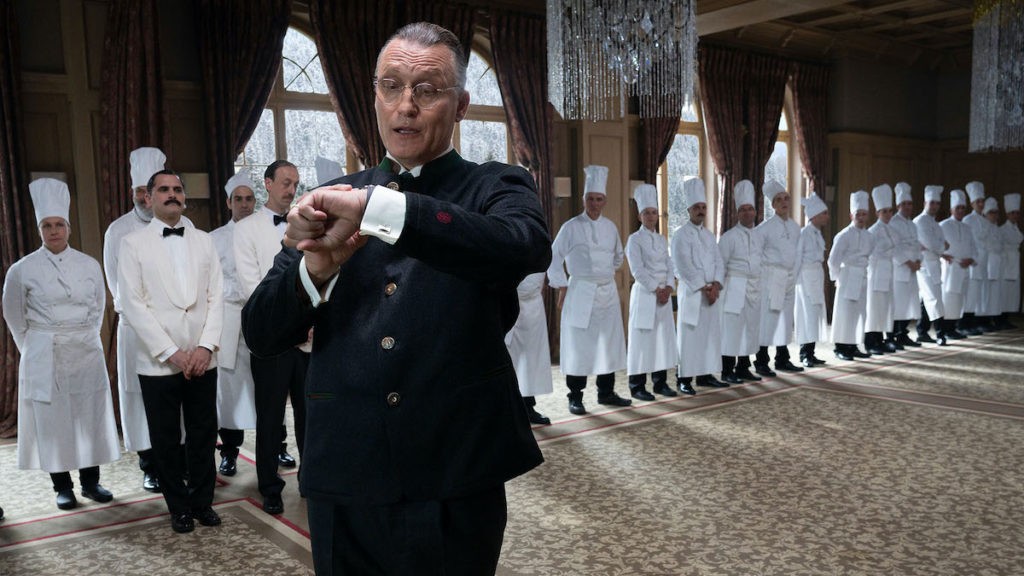
Meanwhile, a washed-up porn actor (Luca Barbareschi, the film's producer) cannot go skiing, and a near-bankrupt tycoon (orange-haired Mickey Rourke in a wig) tries to profit from the general panic over the impending Y2K bug, the expected computer glitch due to the millennium change. The manager (Oliver Masucci), a sad man with pain in his eyes, solves the problems of the rich. They all await the apocalypse, though, characteristically, it never comes.
This is a strange film, not entirely typical of Roman Polanski as it might seem, although a plot with a castle in the mountains where a ball is held for morally dubious citizens has appeared before in the director's filmography. That was 'The Fearless Vampire Killers' – a lightweight parody of Hammer horror films – made between 'Repulsion' and 'Rosemary's Baby', two great films (considered by many to be the pinnacle of the author's work).
In 'The Fearless Vampire Killers', a vulgar film, sometimes unbearably funny and in the finale unbearably sad, many things and ideas were actually formulated that Polanski took with him the following year to conquer America. The idea that world evil is not concentrated in some vampire or phenomenon, but is in everyone, in each person. That any feast is during the plague. That there is no hope, generally. We will see all this later in 'Rosemary's Baby', in 'Chinatown' (which is amusingly quoted here). In 'The Tenant' – the best film ever about the downsides of renting. And even in 'Frantic', another seemingly very lightweight film (Harrison Ford is offered cocaine in a bar restroom!) about how fragile reality, which seems unshakable to us, actually is.
'The Palace' was released fifty years after the most important films and major hits in Polanski's career. A career that, like the director's life, has known ambiguous, sometimes frankly strange turns, though rare failures. One of the few European auteurs who managed to preserve himself in studio Hollywood of the second half of the 20th century, Polanski always knew how to stay away from the current mainstream, anticipating a new turn. 'Rosemary's Baby' was not an ordinary film for its release year, but how many imitations came out in the seventies, not even a film historian who was good at math could count. That happened often with Polanski.
Now everything seems the opposite: 'The Palace' looks like a cumbersome, outrageously outdated attempt, even at the level of humor concept, to fit into the established trend of satire about rich people on vacation. 'Triangle of Sadness', 'Force Majeure', 'Glass Onion'. The character types, themes, and overall social responsibility of capital common to all fashionable satirical cinema, identical hotels and recreation areas – all these components of a guaranteed audience hit found in Polanski's film, in his 'The Palace', not so much a retreat as a mass grave. The comedy of manners has turned into a genuine physical comedy. For example, the idea of modern society as a spectacle, a theater of masks, is realized with excessive literalness – you can't look at the results of most characters' plastic surgeries without tears.

'The White Lotus' is a new satirical HBO series about a vacation in Hawaii that turns into hell... or purgatory.
Open material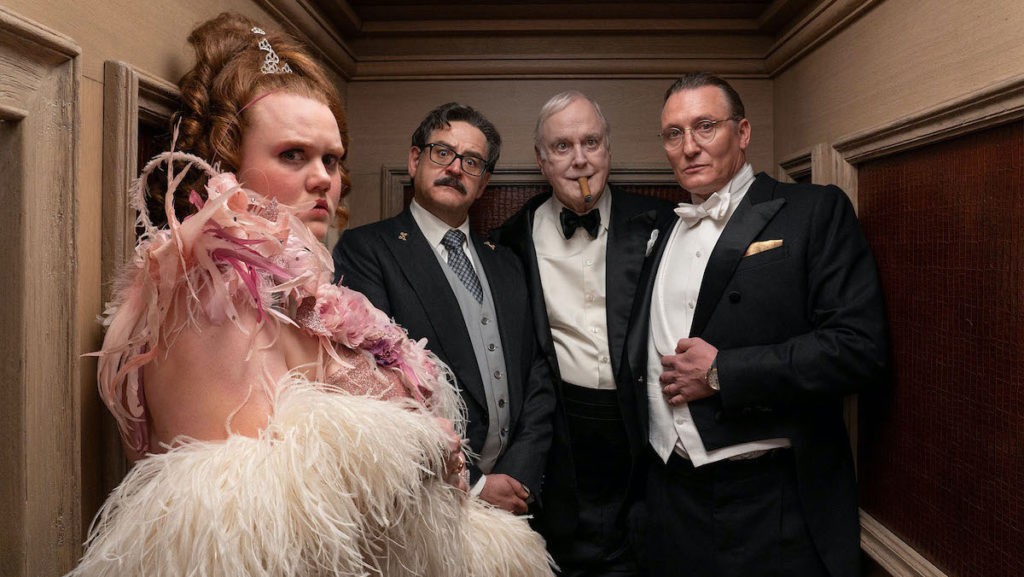
By mixing the components of conventionally good cinema, the great Pole made a blatantly bad film. A corpse with an erection. The marquise flirts with a Polish plumber. The new Russian president on TV promises democracy (this scene was cut, naturally). A plastic surgeon examines the Chihuahua's excrement. His wife with Alzheimer's becomes the object of jokes (that's not okay, of course, if anyone doubted). Mickey Rourke as the tycoon fundamentally denies the idea of good taste. All these sketches add up, at best, to a b-movie version of 'Triangle of Sadness', and in general, to an unexpected remake of 'Peculiarities of the National Hunt'. It's impossible to look away, naturally.
Who would have thought that film history would take such a turn. That erotic thriller star Mickey Rourke would play a petty swindler resembling Shrek. That Fanny Ardant would sniff a Chihuahua's excrement. That Alexander Petrov would play his best role in a strange European comedy. That Polanski would remake 'The Fearless Vampire Killers' with the zest of 'Dumb and Dumber'. Though perhaps the latter was to be expected. As a great director, the Pole always had a special sense of time, knew how to capture the end of an era in a bad joke, delivering a diagnosis with medical precision in the finale instead of a punchline.
In this sense, 'The Palace' is not just a slap in the face to public taste or a rebuke to the director's judges (frankly, most likely guilty), but also a diagnosis. At the center of the film is the anticipation of the apocalypse, the feeling of an inevitable end that never comes. And one can see in this the disappointment of the ninety-year-old Polanski – every era, if you look at it twenty years later, resembles a bad joke about Stirlitz, but at least they ended.
Many of Polanski's films in the 20th century captured exactly that. How decades passed, culminating in some explosion, a complete paradigm shift. The sixties, full of faith in the world and freedom, were replaced by a burst of aggression and paranoia. The conservative eighties turned into the eternal carnival of the nineties. A carnival that never ended. And now our era, following the nineties, is also a time of postmodernism, post-truth, post-irony. The director seems to add: and post-apocalypse.
Everyone in 'The Palace' awaited the end of the world, but it didn't come. And not because they deserved a miracle or anything like that. Simply, in the history of an illness, the most terrifying thing is its endlessness; in a truly bad joke, the hope for a punchline is lost somewhere in the middle. The film itself doesn't end so easily either, and, for example, the cut scene can be watched on all TV channels just a month later. And 'The Palace' should be shown the same way – its potential as a folk New Year's comedy is truly inexhaustible.
Comments
0No comments yet.
Sign in to join the discussion.