
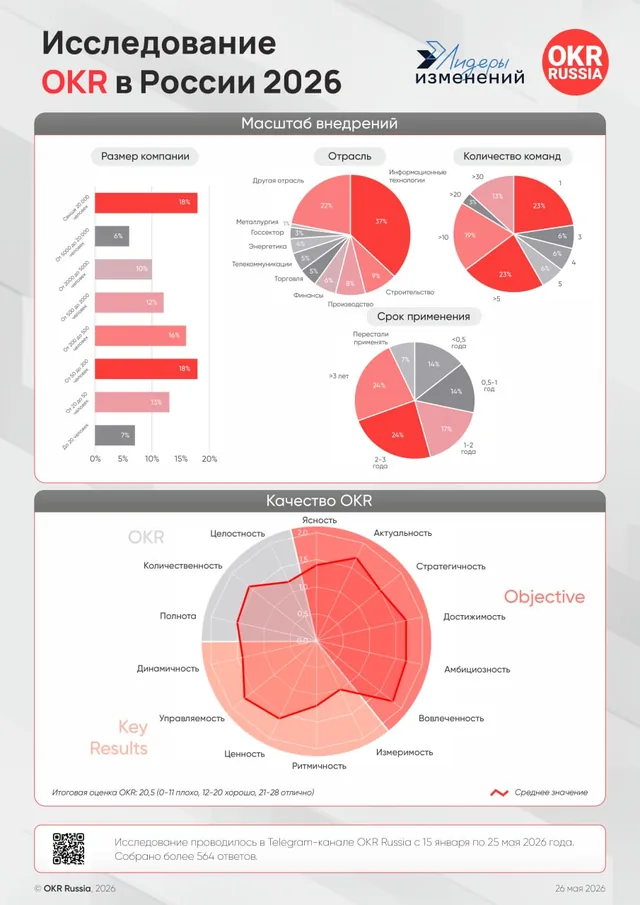
The goal-setting market has entered a phase of maturity. If a couple of years ago the main question was: "should we implement OKR?", today 76% of teams are proud of their goals, and the average OKR quality index reached 20.37 out of 23 possible points (89%). Of course, this is self-assessment, it would be interesting to see how OKRs actually sound, but the trend is clear: the framework is simple and understandable.
Key insights:
⭐ 78% of respondents consider their goals achievable, but requiring serious effort. At the same time, two-thirds (67%) realize: to achieve results, they will have to break habitual processes. This is no longer about formal planning, but about using the framework as a tool for change.
⭐ IT remains the locomotive (37% of participants), increasing its share from 32% in 2025. The most interesting thing is diversification: construction (9%), manufacturing (8%), finance (6%), telecom (5%) and "other industries" (22%).
⭐ If earlier these were experiments in one or two teams, now 23% of companies use OKR in more than 10 teams, and 16% in more than 20. Almost half of the participants (48%) have 2+ years of experience. The Russian market has accumulated enough expertise.
⭐ Companies have learned to formulate inspiring, strategically significant goals. But with Key Results — the nearest growth area.
⭐ Main pain points: incomplete coverage of goals with metrics, difficulties with regular data availability, problems in forecasting achievements.
If you decide to conduct a self-diagnosis, the study includes an OKR quality assessment template.
📖 Read the article
📲 MAX 👮♂️ VK ☺DZEN 🙃 SETKA ✈️ TG #research #okr #goals #business #results #it
Comments
0No comments yet.
Sign in to join the discussion.