
A fresh study from iTrend and TsAMT (with participation from Russoft and iSpring) confirms that the IT market has entered a phase of severe "cooling" and rationalization.
Here are the key takeaways 👇
📉 Macroeconomic factors
For the first time in 5 years, the gross value added of the IT sector in Russia has declined — minus 7% in 2025 (to 2.6 trillion rubles). Money has become expensive, investors — timid. Companies are no longer expanding teams "on credit," focusing only on profitability and efficiency.
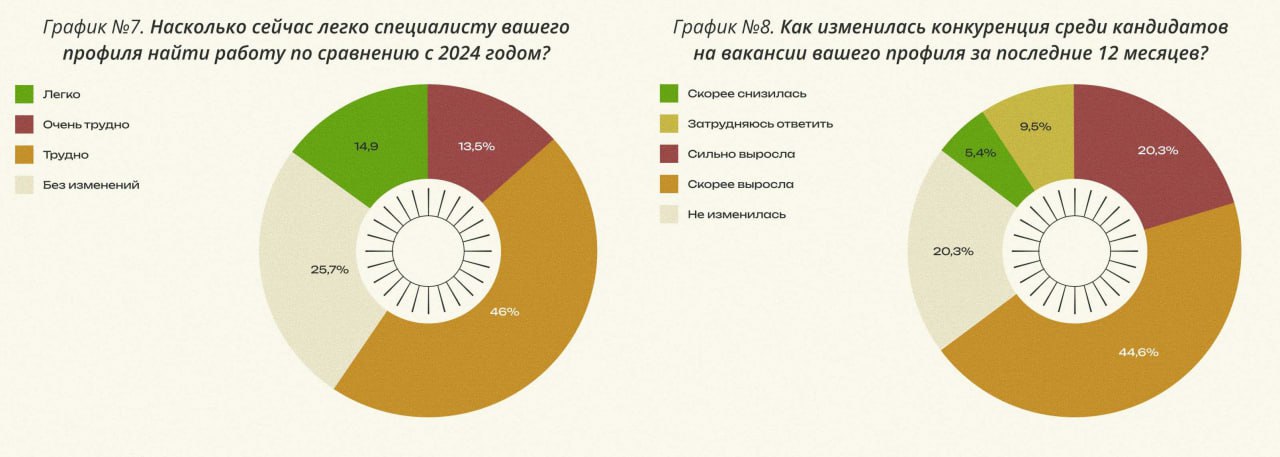
🚫 Employer's market: 19 people per position
Competition for jobs has reached an all-time high since 2019.
— The number of vacancies in 2025 fell by 22%.
— Competition: 19 applicants per position.
— Job search now takes an average of 3 months or more.
For DevOps engineers, the situation has changed dramatically: if a year and a half ago they could choose from 10 offers a day, now a single vacancy receives up to 300 responses.
🥶 Salary hibernation
Salary growth has virtually stalled.
— 42% of IT professionals faced a freeze on indexation.
— The average market increase was a meager 4% (effectively an attempt to keep up with inflation).
— The median settled at 180,000 rubles.
Employers have become "stricter": knowing a new tech stack no longer guarantees a pay raise. Companies want "more skills for less money." Growth persists only for scarce Middle+ and Senior specialists, who are retained by any means to prevent processes from collapsing.
🤖 Death of the classic resume and AI arms race
Artificial intelligence has completely discredited the standard selection process.
— 55% of respondents believe AI has made hiring more difficult.
— Resumes and cover letters have lost their meaning: they are now mass-generated by neural networks.
Candidates have shifted to "unethical" practices:
— 60% write cover letters using AI.
— 50% use AI to complete test assignments and pass technical interviews (real-time hints).
In response, employers are tightening the screws: introducing endless verification stages and "live" coding, which inflates hiring timelines. About 50% of applicants are screened out before professional skills are even tested, based on formal criteria.
🫠 Shadow employment and burnout
Instead of mass layoffs, businesses have chosen a strategy of "quiet hiring" and optimization.
— A trend toward "shadow employment" has emerged: specialists work remotely for multiple companies simultaneously to maintain their usual income level.
— The main reasons for dismissal are now not relocation, but low efficiency and burnout.
IN WELDERS 🤣
#market_decided
Comments
0No comments yet.
Sign in to join the discussion.