
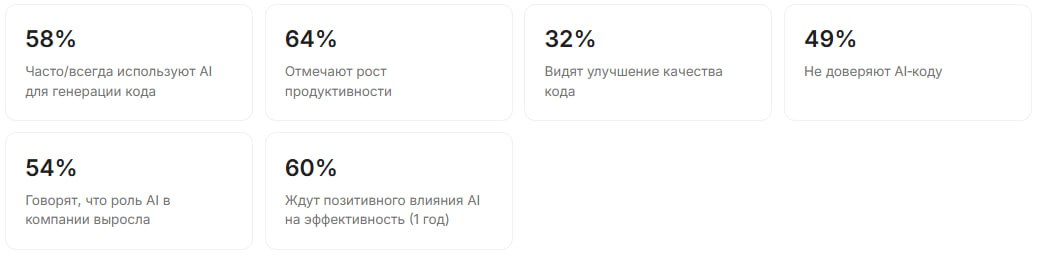
T-Bank released a fresh AI4SDLC research for 2025. The picture is extremely ironic. We learned to generate code at machine-gun speed, but absolutely have no idea what to do with it next.
1. Verify, don't trust
The numbers are striking: 58% of engineers use AI for code generation constantly. Meanwhile, 49% (almost half!) do not trust this code. Only 11% trust it unconditionally.
2. The bottleneck has moved
Programming is no longer the bottleneck. Now everything gets stuck at the code review and testing stage. The increase in individual productivity (reported by 64% of respondents) crashes against the rocks of team processes. If you crank out features twice as fast, but your lead reviews them for the same week — the overall process time won't change. Speeding up one section just creates a jam at the next.
3. Legacy — kryptonite for AI
For tasks with high context and old code, only 18% use AI. Why? Because the neural network is good on a "blank slate" but fails against layers of decade-old workarounds. For AI to truly help with Legacy, your documentation, ADRs, and RFCs must be in perfect shape. But they aren't. 🤭
4. Skill erosion and "engineering thinking"
37% noticed they became better at writing code with AI, but there's a downside — the risk of basic skill degradation. Why remember syntax or algorithms if
Tab will autocomplete everything? So the bottom line for now is: the neural network works like a turbo typewriter, but then tech leads and reviewers cry blood, cleaning up the results of this "productivity."
Comments
0No comments yet.
Sign in to join the discussion.