
Karpathy Counted Who Will Be Replaced by Neural Networks 🤖
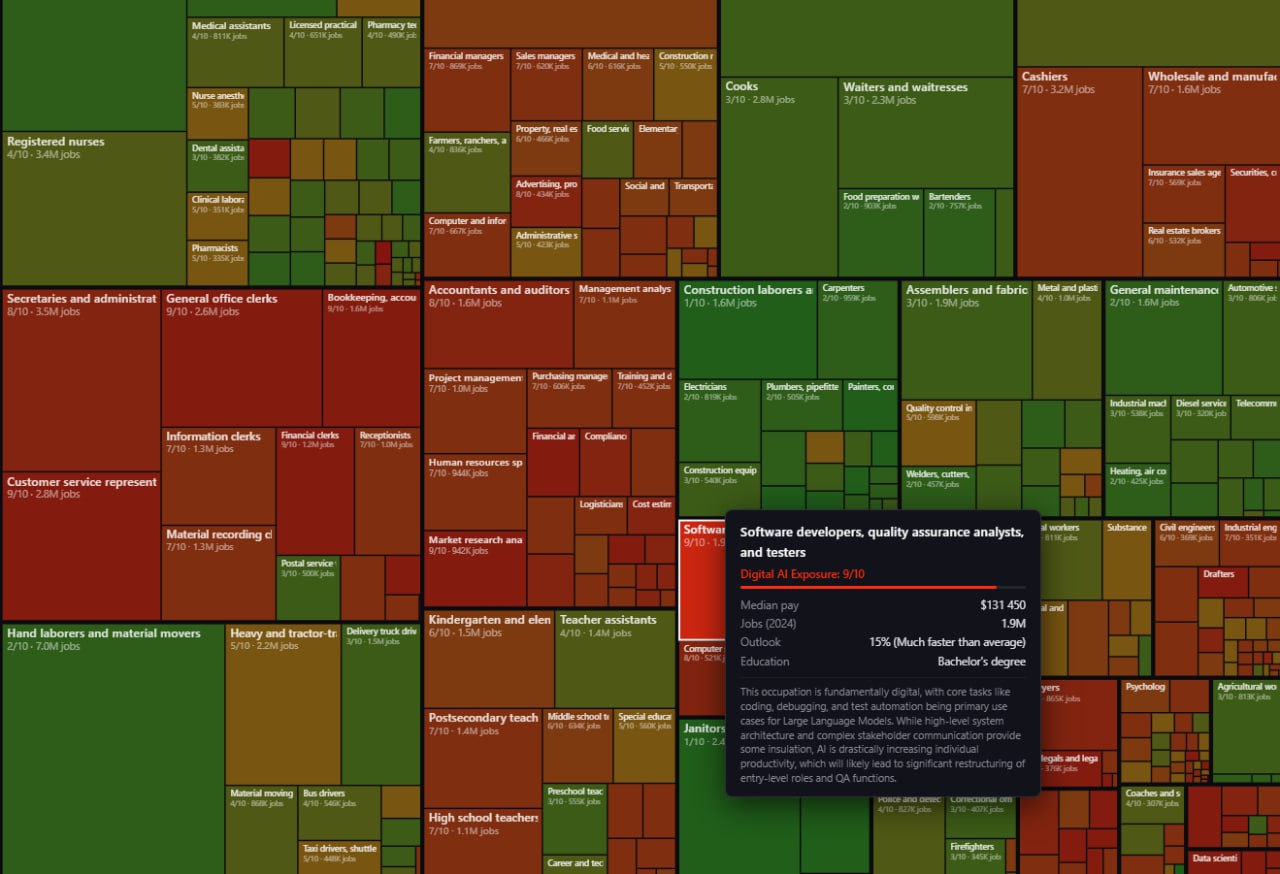
Andrej Karpathy released another interesting pet project — US Job Market Visualizer. This is an interactive map of the US labor market (143 million jobs, 342 professions), where each specialty is rated by its level of "AI Exposure" (vulnerability to AI).
What about programmers?
Software Developers have a score of 9/10. We are in the deep red zone.
Does that mean it's time to learn how to lay tiles? Not at all. Karpathy points out that high vulnerability does not equal the disappearance of a profession. Writing code, debugging, and test automation are ideal use cases for LLMs. The productivity of a single engineer skyrockets.
Demand for developers may even increase, but they will be paid for designing architecture, communicating with stakeholders, and solving business problems. But for linear coders, blind ticket executors, and manual testers, my condolences — this segment will be restructured first.
What else is interesting:
▫️ Only 4.4% of jobs have minimal risk (roofers, loaders, janitors). Physical labor is still out of the game.
▫️ The higher the salary and education, the more you are in the crosshairs of AI. Professions with income from $100k have an average vulnerability score of 6.7.
▫️ In the high-risk zone (7 points and above), $3.7 trillion in annual salaries are generated.
How it works under the hood
For a Python developer, this repository is an ideal, crystal-clear reference for how to build data processing pipelines with LLMs nowadays. No overcomplicated junk, all using standard tools:
1️⃣
scrape.py — non-headless Playwright (BLS blocks bots) to extract raw HTML.2️⃣
parse_detail.py and process.py — classic BeautifulSoup4 to clean up the layout and convert to clean Markdown. No magic, just context preparation.3️⃣
score.py — the most important part. The script feeds Markdown job descriptions into Gemini 3 Flash via OpenRouter. The system prompt strictly defines scoring criteria (0 to 10) and requires returning only JSON like {"exposure": int, "rationale": "string"}. 4️⃣
build_site_data.py — assembles the final JSON for the frontend in vanilla HTML/JS.If you've been wanting to attach an LLM to analyze some of your boring data (reviews, logs, resumes) — fork the project. Throw out Karpathy's prompt about "AI Exposure", write your own (e.g., "Assess the likelihood of this job being automated by humanoid robots" or "Assess the risk of outsourcing"), run the script, and get ready-made analytics.
🔗Source code on GitHub
Comments
0No comments yet.
Sign in to join the discussion.