Over the years at FunCubator and in venture capital in general, I've seen hundreds of pitch decks. The decision "interesting" or "into the trash" is made very quickly. Sometimes the first two slides are enough.
I'll tell you what makes an experienced investor's eye twitch, and what, on the contrary, makes them want to scroll further.
Red flags:
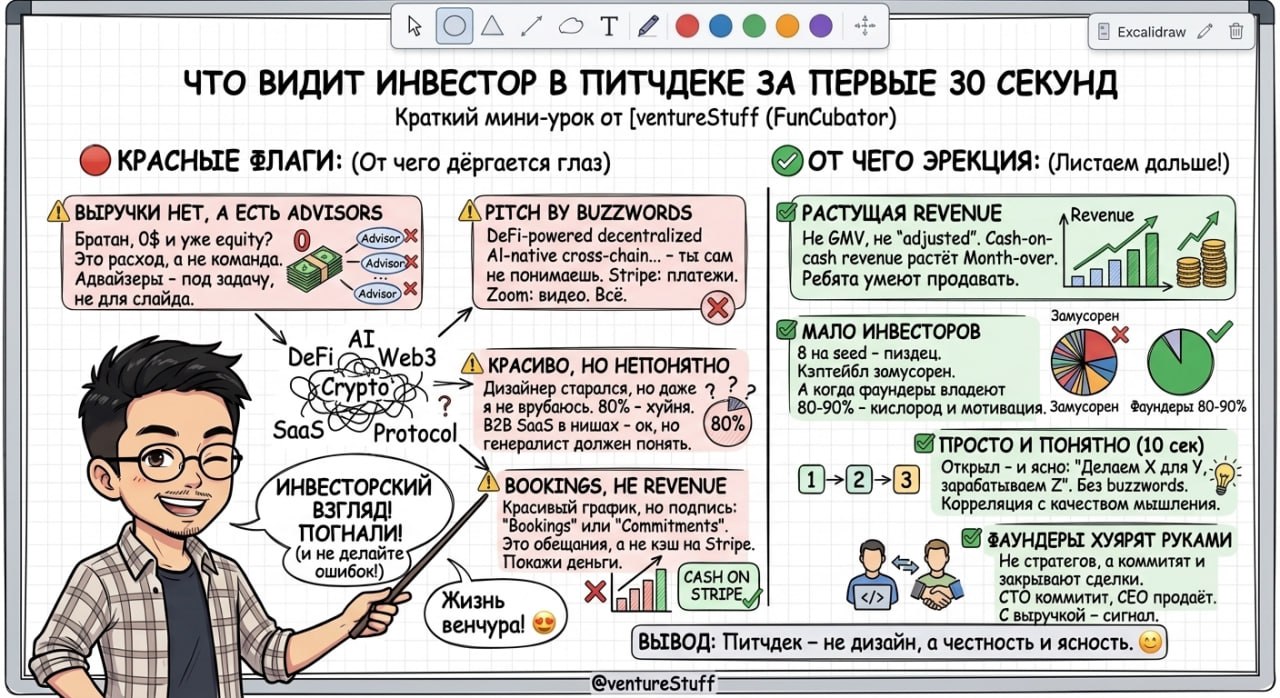
1/ No revenue, but the "Team" slide already has two advisors. Bro, you have zero dollars and you've already given away equity to people who call you once a month for 30 minutes? That's not a team, that's an expense. Advisors are needed when there's a specific problem you can't solve yourself. Not for slide decoration.
2/ Product description like "DeFi-powered decentralized AI-native crypto token-based cross-chain liquidity aggregation protocol." If you need 15 buzzwords to explain what you do, you don't understand what you do yourself. The product should be explainable in one sentence. Stripe - payments for the internet. Zoom - video calls. That's it.
3/ The first slide looks beautiful, the designer did a great job, but even I - someone who has professionally watched startups for 6 years and built a SaaS myself - can't figure out what the product is. I'd bet 80% it's crap. Yes, there are tricky B2B SaaS in narrow niches like compliance for pharma or tooling for devops where I just don't have expertise. But if you're pitching to a generalist investor and they don't get it, that's your problem, not theirs.
4/ A beautiful growing chart, but the label is not "Revenue" but "Bookings" or "Commitments." This is classic. Bookings are promises, not money in the bank. Commitments are basically "they told us they'd buy." Well, great, I've been promised a lot of things too. Show the cash that landed in Stripe.
Now, what almost instantly gets any investor excited:
1/ Growing cash-on-cash revenue. Not GMV, not bookings, not "adjusted." Real money in the bank, growing month over month. This immediately says: these guys know how to sell and someone needs the product.
2/ Few investors on board. If a startup at seed stage already has 8 investors, that's a mess. Everyone wants their own thing, everyone has their own opinion, the cap table is cluttered. But when founders own 80-90%, they have oxygen, motivation, and the freedom to make decisions quickly.
3/ It's clear what they do within 10 seconds. Opened the first slide and immediately: "we do X for Y and earn Z." No buzzwords, no "revolutionary platform." Simple and clear. This, by the way, correlates with the quality of the founder's thinking - if they can explain something complex simply, they truly understand it deeply.
4/ Both founders are hands-on. One builds the product, the other sells. Not "strategizing," not "managing," but directly doing the work. The CEO closes deals themselves, the CTO commits code themselves. When I see such a team of 2-3 people with growing revenue, that's the strongest signal that these guys are real.
In short, a pitch deck is not about design or the number of slides. It's about honesty and clarity of thinking. The best pitch deck I ever saw was 6 slides with zero animation. But everything was clear and the numbers were growing.
@ventureStuff
Comments
0No comments yet.
Sign in to join the discussion.