
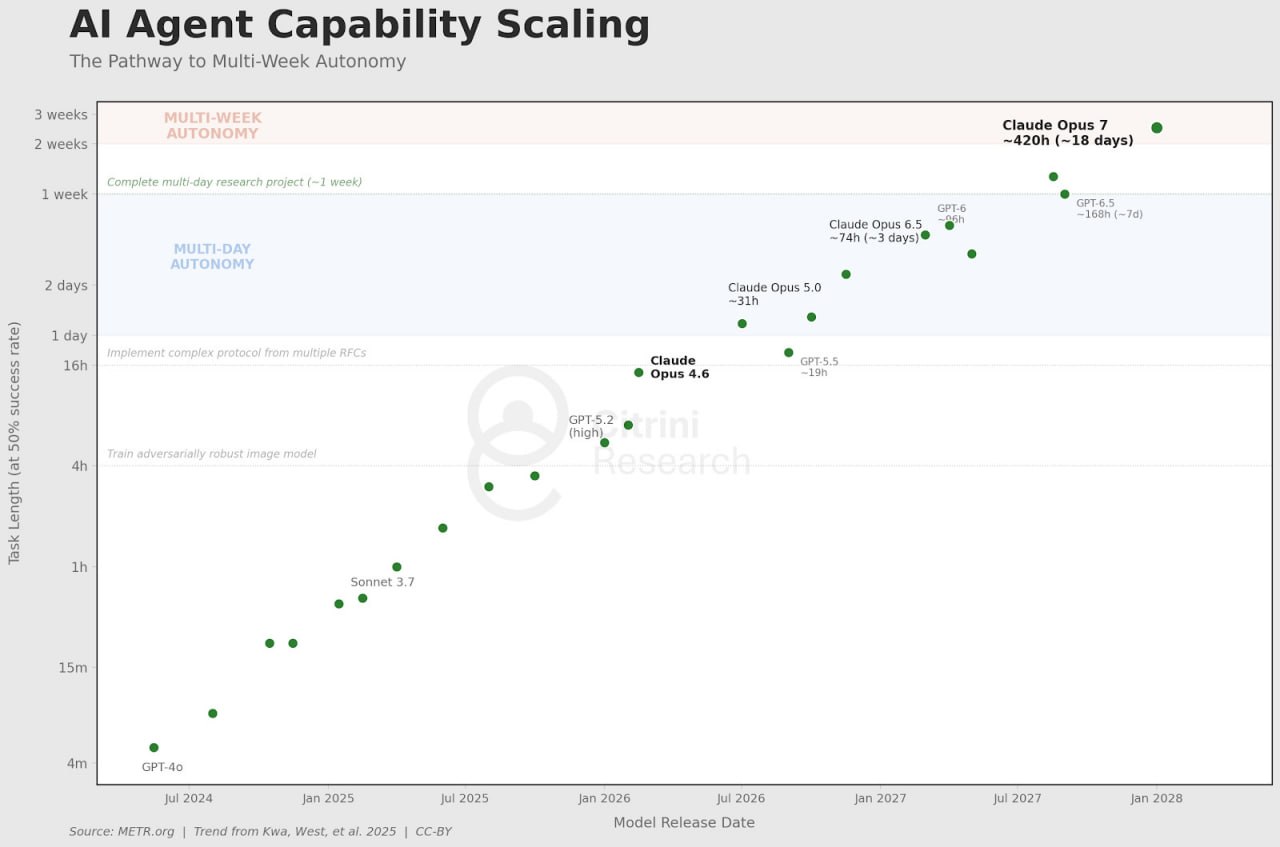
The End of the Intelligence Premium, or Why Your Code Is Heading Toward the Cost of Electricity 📉
Analysts from CitriniResearch released a macroeconomic forecast model outlining how AI agents will disrupt the current IT market. It is written in the form of a macroeconomic retrospective from 2028, looking back at events from 2026–2027.
1️⃣ Agentic Programming and the Death of SaaS
According to the forecast, a competent developer using a tool like Claude Code could clone the core of a mid-market SaaS product in a couple of weeks. When CIOs see renewal bills for corporate subscriptions at $500k, they logically ask: "Why not build this in-house with a couple of engineers?" The entire layer of many services gets cut, and their departments already demand 30% discounts just under the threat of writing a replacement themselves.
2️⃣ Cannibalization of Business Models
Even giants are not safe. The "per-seat" sales model becomes toxic. Clients lay off 15% of their staff due to AI adoption ➡️ mechanically cancel 15% of licenses ➡️ the vendor loses revenue, lays off its own developers, and pours the saved payroll into AI to maintain development with fewer people. The circle closes.
3️⃣ Collapse of Classic Outsourcing
Indian IT giants and other sweatshops were built on a simple idea: their developers cost significantly less than American or European ones. But the marginal cost of an AI coder is approaching the cost of electricity. IT service exports collapse, contracts are massively canceled.
4️⃣ Death of UI/UX
Many large businesses survive only due to friction, human laziness, and the UX wrapping around it (e.g., users are too lazy to compare prices across five apps). But AI agents are not lazy. They don't care about pretty buttons, gamification, or the habit of clicking a familiar icon. Brand loyalty drops to zero, B2C service margins shrink, and armies of frontend developers building "user-friendly interfaces" lose their purpose. The interface becomes an API.
4️⃣Creation of New Jobs?
The most popular argument: "Innovation always creates more jobs than it destroys." Yes, AI creates new roles—security researchers, AI infrastructure engineers. But for every new job, dozens are destroyed. And the pay is often significantly lower.
The idea that "programmers will just become AI managers" doesn't work because AI itself can already coordinate tasks and manage other agents. People will set the direction and "define the taste," but very few are needed.
Throughout modern economic history, human intelligence has been a scarce resource. The ability to analyze, write code, and make decisions commanded a so-called intelligence premium.
The study's conclusion is simple: this scarcity is over. Intelligence is becoming mass-produced and cheap. And the entire financial system, built around expensive white-collar brains, is completely unprepared for this.
What are your bets on how quickly this forecast will become our everyday reality? 👇🏻
Comments
0No comments yet.
Sign in to join the discussion.