
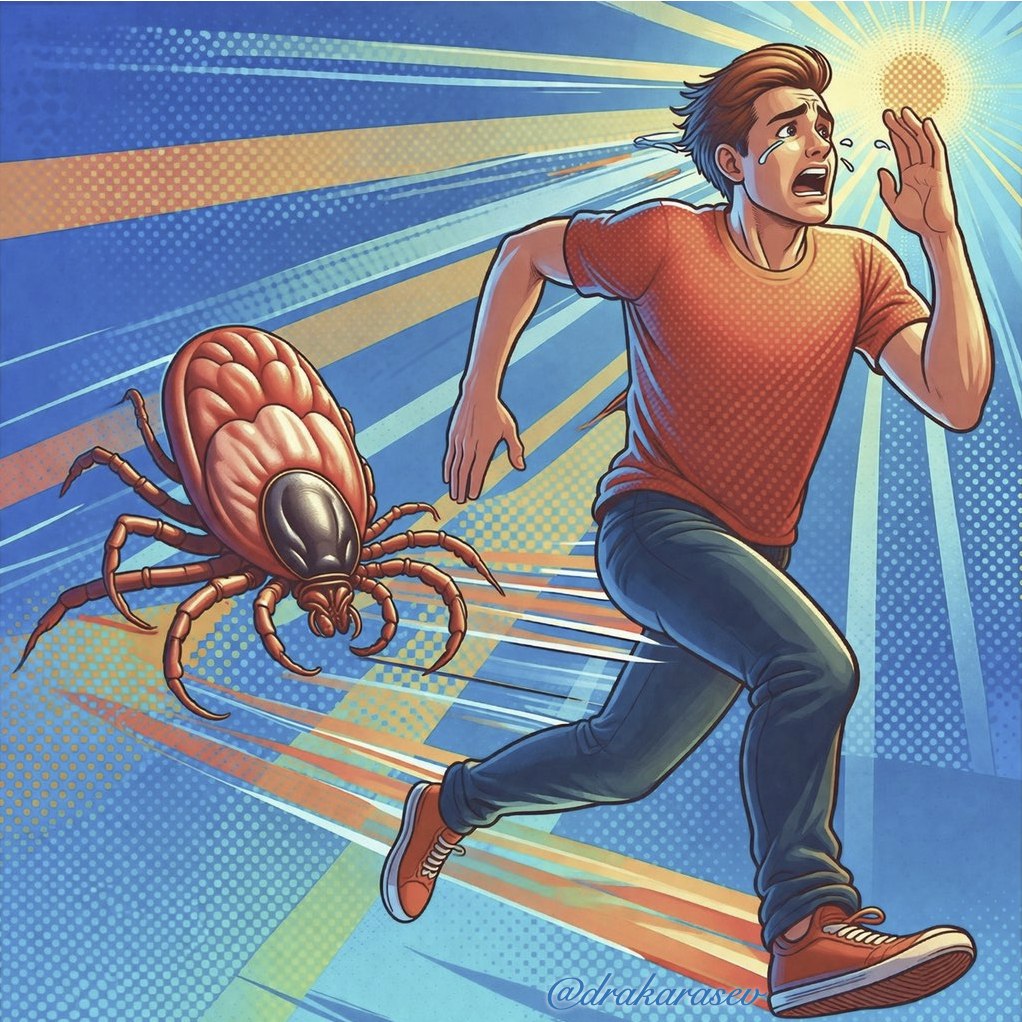
They are called Hyalomma. They are 3 times larger than ordinary Moscow region ticks (up to 2 cm). They are carried by birds over long distances. They are found in arid steppe areas. They do not like coastal areas. They carry several deadly infections for which there is no effective treatment…
🕷️ECDC map 2023. Russia is already there 🕷️
Rospotrebnadzor is silent for now.
Where has it been spotted according to this map? (European regions)
Endemic (permanent): Spain, Portugal, Italy, Greece, Cyprus, Bulgaria, Albania, Croatia, Serbia, Romania, Ukraine.
Migrating northeast due to warming.
Facts about the Hyalomma tick:
• In addition to our tick-borne encephalitis and Lyme disease, there is added carriage and risk of contracting: • Rickettsiosis (Rickettsia aeschlimannii) • Crimean-Congo hemorrhagic fever (CCHF) with a mortality rate of 10–40% (learned from reports from France since 2022) • Aggressive: It actively seeks a host, runs at the speed of an ant, bites during the day, larvae/nymphs travel on birds. • Loves steppes, bushes, dryness. • 3 stages: larva/nymph/adult — all bite.What to do?
• Before a walk in the steppe - tightly tuck pants into socks • Treat with repellents (DEET) - verified information, it works on them. • Bring cheap cream or Vaseline, a small jar, test tube, or sealed bag (for the tick). • Check your body after walks. • If bitten - do not panic and do not smear the tick on yourself, do not flick the tick, but thickly apply cream/Vaseline to suffocate it and carefully remove it with twisting motions and put it in a bag. Contact a clinic and give the tick to Rospotrebnadzor (or pay for lab testing). Insistently ask when diagnostics for rickettsia and CCHF will be available.
@drakarasev
Comments
0No comments yet.
Sign in to join the discussion.