
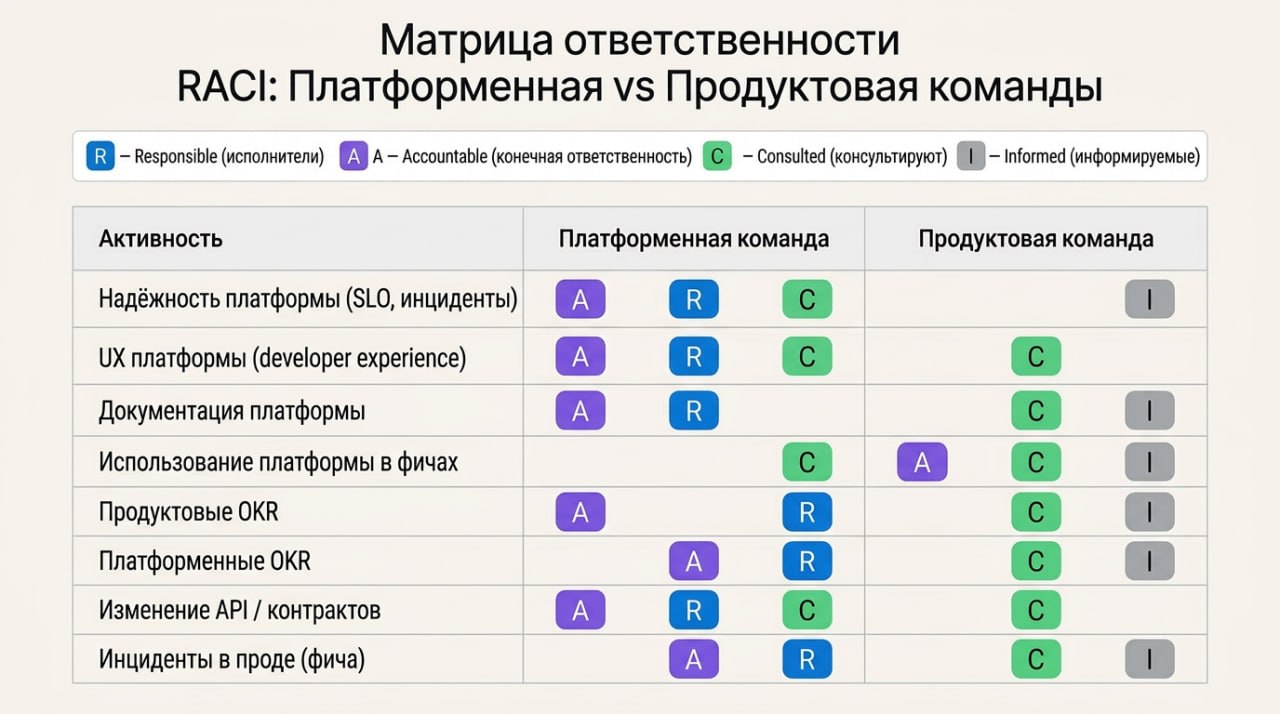
In classic DevOps, there is much talk about "shared responsibility," but in practice, it often degenerates into an anti-pattern: "when everyone is responsible for everything, no one is responsible for anything." Incidents linger for hours, the product degrades, and teams get lost in the question, "Who actually fixes this?"
Shared responsibility without an explicit owner turns into a matrix of irresponsibility: metrics drop, users suffer, and retrospectives only discuss "processes" and "communication." Explicit product ownership does the exact opposite—each system and layer has a specific owner who is accountable for the outcome, not just to "participate." To achieve this, platform teams must think like product teams: they should be responsible for reliability, platform UX, documentation, and clear interfaces, not just for "infrastructure and tools."
Instead of informal agreements like "write to Pete, he did this once," clear interfaces emerge: APIs, SLOs, service catalogs, onboarding guides, and standard change processes. Teams move faster not by bypassing controls, but through built-in controls—checklists, automated checks, standard pipelines, rather than manual approvals in chats.
Hybrid work and distributed teams amplify this need manifold: when you rarely meet offline, "verbal agreements" don't help. Transparent policies, asynchronous processes, and clear goal-setting through OKRs (Objectives and Key Results) are needed, where each objective has measurable key results and a clear owner. Then it becomes clear not only "who does what" but also "what counts as success" at the product and platform level.
A practical tool that works well in such conditions is the RACI matrix (Responsible, Accountable, Consulted, Informed). It helps explicitly define: who performs the work (R), who bears ultimate accountability for the result (A), who is consulted as an expert (C), and who just needs to be informed (I). In distributed product and platform teams, RACI provides a common language that pulls accountability out of the "gray zone" and transforms DevOps from a slogan about "shared pain" into a manageable system.
Comments
0No comments yet.
Sign in to join the discussion.