
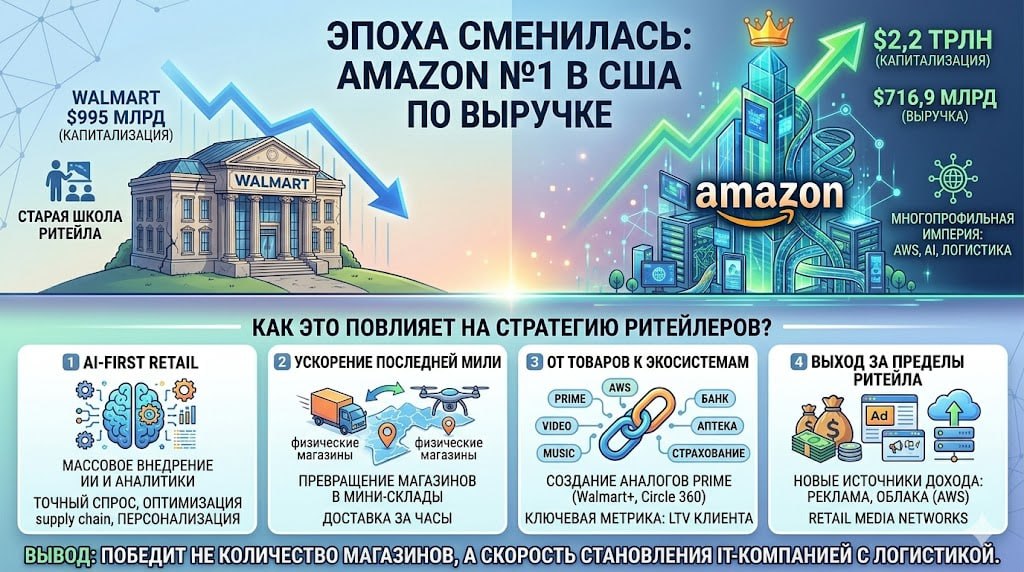
In 1994, Jeff Bezos founded Amazon as an online bookstore. Three decades later, it is a multi-industry empire that sells goods, owns cloud infrastructure (AWS), develops artificial intelligence, and controls logistics.
The market believes in this strategy: Amazon's market capitalization has reached $2.2 trillion, more than double Walmart's value ($995 billion).
How will this affect retailers' strategies?
1️⃣ AI-First Retail
Retailers are forced to massively adopt generative AI and predictive analytics to predict demand more accurately than Amazon (whose revenue is growing faster), optimize supply chains in real time, and offer personalized recommendations.
2️⃣ Accelerating the Last Mile
Retailers are forced to turn their physical stores into mini-distribution centers.
3️⃣ From Products to Ecosystems and Subscriptions
Amazon is not a store; it's an ecosystem (Prime, AWS, Video, Music). Retailers will try to create their own Prime analogs to lock in customers. Walmart is developing Walmart+, Target — Circle 360. Other retailers will seek partnerships. For example, combining retail subscriptions with banks, pharmacies, insurance, or entertainment. The key metric is now not average check, but customer LTV.
4️⃣ Expanding Beyond Retail
Amazon makes huge money from advertising and cloud (AWS), not just selling goods. Retailers will look for new revenue sources. Creating their own retail media networks based on customer data.
The conclusion: the winner will not be the one with more stores, but the one who fastest becomes an IT company with logistics infrastructure.
📲 MAX 👮♂️ VK ☺️DZEN ✈️ TG #Retail #Strategy #Marketing #Amazon #Walmart #AI #Logistics #Ecom #BusinessTransformation
Comments
0No comments yet.
Sign in to join the discussion.