
Existential crisis of a 47-year-old senior 💀
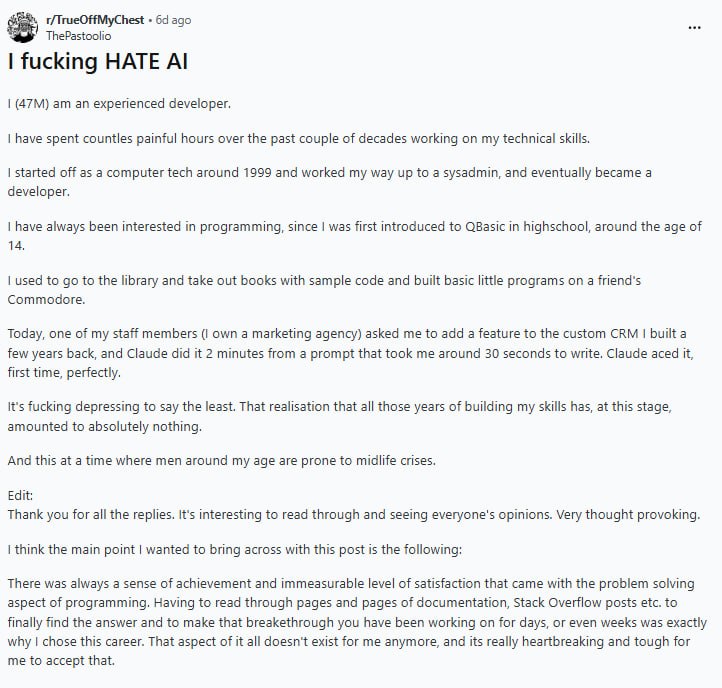
On Reddit, a heartfelt post from an experienced developer went viral. The guy has been in the industry since 1999, started with QBasic on floppy disks, polished his hard skills for decades, and now runs his own agency.
The other day he needed a new feature for his custom CRM. He spent 30 seconds on a prompt. Claude wrote everything in 2 minutes. Perfectly, on the first try, without a single error.
The result: the guy fell into severe depression. It felt like 25 years of his experience had just been multiplied by zero.
Later he updated the post, and the real cause of his pain emerged. He doesn't miss writing lines of code. He misses dopamine. Before, you could spend three days reading documentation, digging through Stack Overflow, suffering, and then—bam!—you find an elegant solution. That gave a powerful sense of self-worth. Now it's gone. Programming for him has turned into boring delegation.
The comments gathered a roll call of industry veterans who quickly explained why the author (and everyone burying the profession) is looking at the situation from the wrong angle. I've collected the essence of the discussion.
1️⃣ The illusion of perfect code
Claude produced a working result only because the prompt was written by a person with 25 years of background. The author knew the architecture, understood how the system works, and could verify the generated piece in seconds.
Give the same task to someone without that background. The AI could generate beautifully looking but completely non-functional garbage. The neural network doesn't understand business context.
As aptly noted in the comments: "AI is a very fast intern who lies with a straight face and requires total supervision."
2️⃣ Shift in abstraction level
Programming has always evolved through abstractions. First, you controlled hardware manually, then OSes appeared. You wrote in assembly—high-level frameworks emerged. No one now cries over manual memory management.
AI is just a new layer. Troubleshooting hasn't gone away; it has shifted to a higher level. Now we debug not syntax, but architecture, system integrations, and model hallucinations.
3️⃣ Typing code is not development
The main bottleneck in engineering has always been translating chaotic customer requirements into strict logic. AI only sped up the mechanical stage of writing lines. Requirements gathering, planning, QA, and dealing with scaling issues are purely human tasks. Neural networks took the boilerplate, not the profession.
4️⃣ Role shift: from coder to editor
The industry is currently undergoing a transformation. An engineer's value now lies in their ability to quickly read, understand, and validate someone else's (generated) code. Without the experience of a senior who can verify AI's work, businesses will drown in uncontrollable generated legacy when trying to add a second feature.
In short, seniors are now in a golden age: they can multiply their productivity by 10x. But those who should really worry are fans of "vibe coding" without a fundamental base. And old skills haven't been nullified. It's just that now you've been given an excavator for earthworks, and you're sad that you no longer need to dig with a shovel.
Comments
0No comments yet.
Sign in to join the discussion.