
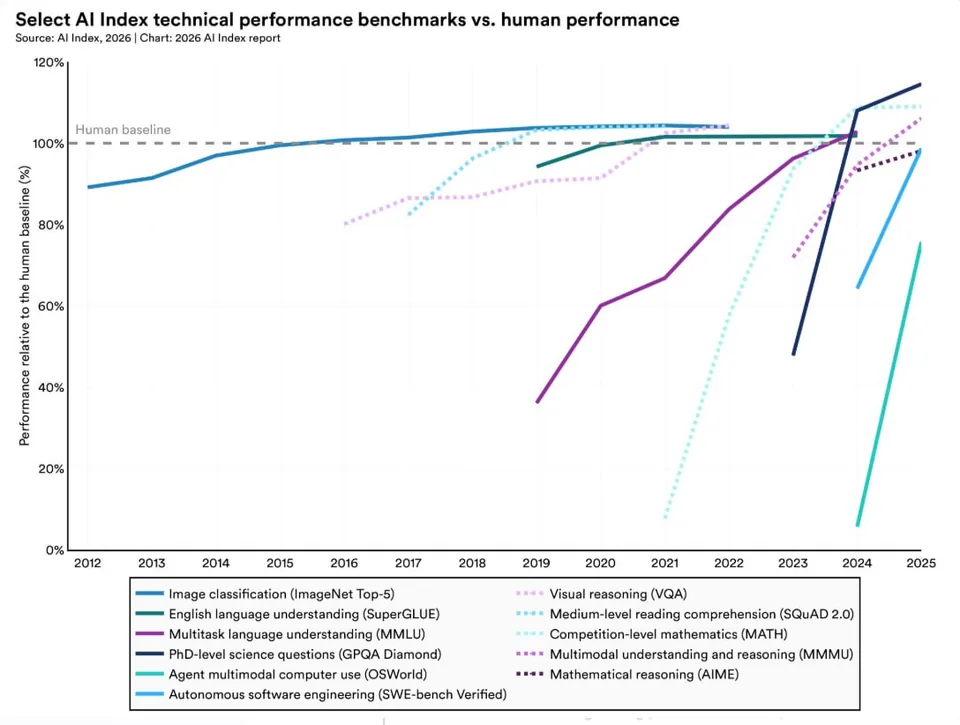
The annual Stanford AI Index Report is out. You don't need to read all 400 pages; here are the most important facts 👇
💻 Many programming benchmarks are broken
The
SWE-bench Verified metric, which evaluates the ability to solve real GitHub issues, jumped from 60% to nearly 100% in just one year. Tests designed to last years are saturating in months. In Terminal-Bench (agent work in a real console: from compilation to server deployment), accuracy rose from 20% to 77.3%.🗑 The internet is dead, synthetic data doesn't save
Since January 2025, >50% of new content on the internet has been AI-generated. Yet training LLMs purely on synthetic data still doesn't work—quality doesn't improve. All the magic now lies in data-centric approaches. The
OLMo 3.1 Think 32B model achieves results on par with Grok 4 while having 90 times fewer parameters. The secret: aggressive pruning, deduplication, and curation of the training set, not mindless scaling of weights.⚔️ End of American monopoly and era of secrecy
The technological gap between the US and China has virtually disappeared. Chinese models are nearly on par with American flagships. The difference among the top 4 models is microscopic.
At the same time, the industry has become completely opaque. For the most powerful systems, neither architecture, training scripts, nor dataset sizes are disclosed anymore.
🤡 Jagged Frontier
Neural networks win gold at the International Mathematical Olympiad (Gemini Deep Think scored 35 points), but cannot simply tell time from an analog clock (they err in 49.9% of cases, median error from one to three hours). On OSWorld (desktop application control), agents fail every third task. The ability to solve the most complex math does not imply common sense.
📉 The market for juniors is collapsing
Proven developer productivity gains (+26% more pull requests merged with AI) hit entry-level positions. The number of employed programmers aged 22–25 in the US has dropped nearly 20% compared to 2024. Researchers call this "seniority-biased technological change"—AI replaces junior labor while hiring of senior developers continues to grow.
🔌 Infrastructure fragility
Global AI computing power is growing 3.3 times each year (reaching 17.1 million H100-equivalents). The US hosts over 5,400 data centers (10 times more than any other country), but nearly all advanced AI chips worldwide are produced at a single TSMC factory in Taiwan. AI data center energy consumption has reached 29.6 GW, comparable to the peak consumption of the entire state of New York.
Inference is no less resource-intensive: the annual water consumption for
GPT-4o generation alone equals the drinking needs of 1.2 million people.
Comments
0No comments yet.
Sign in to join the discussion.