
🐲
Everyone keeps praying for Nvidia's market cap and waiting for Sam Altman's next model, while a real tectonic shift may be happening in another part of the planet.
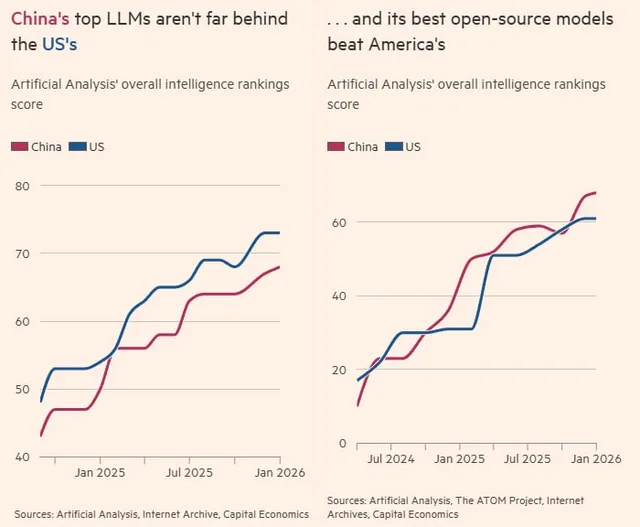
Financial Times recently published excellent analysis, the gist of which is simple: the AI race is a marathon, not a sprint for the biggest LLM.
And here's why the US risks losing the lead:
1️⃣ Algorithmic efficiency beats brute force
The US undoubtedly leads at the frontier of state-of-the-art models thanks to unlimited access to top-tier Nvidia H100/H200 chips. But China has proven that hardware limitations can be circumvented. It turns out that algorithmic efficiency, quality data, and smart architecture allow training models that rival American giants while using far less computing power.
2️⃣ The bottleneck isn't chips, it's the power grid
The LLM race has hit a physical wall. According to investment bank estimates, 8 out of 13 regional energy markets in the US are already at capacity. There simply isn't enough electricity for new data centers.
In China, thanks to strict state planning and infrastructure control, the surplus of data center capacity by 2030 will exceed global demand threefold. Jensen Huang recently complained that building a data center in the US takes 3 years, while in China it can be done over a weekend.
3️⃣ Open-source expansion
The share of downloads of Chinese open-source models on Hugging Face has already surpassed the American share. While US corporations hide their developments behind expensive APIs, China freely distributes powerful models to emerging markets. Developers grab them, fine-tune them, and deploy them on local servers. The classic vendor lock-in works less and less when there's a free and equally smart alternative.
4️⃣ Embodied AI > API wrappers
The main paradigm shift. The market has outgrown the "wow, it can write code" stage. The focus is shifting to "embodied AI" — embedding neural networks into physical objects: robotics, automotive, smart manufacturing, and IoT.
And here China holds a royal flush: absolute control over rare earth metal supplies, unmatched manufacturing capacity, and the state's ability to directly inject technology into the real economy.
The winner is not the one who creates the smartest LLM in a spherical vacuum for $10 billion. The winner is the one who can embed a "just good enough" model into every microwave, machine tool, and car on the planet faster and cheaper.
And the market will pay specialists for:
🔵 The ability to deploy, fine-tune, and deploy open-source models on the client's local infrastructure.
🔵 Inference optimization: quantization, pruning, working with "good enough" but small models.
🔵 Integrating AI with real business processes and non-standard hardware.
Comments
0No comments yet.
Sign in to join the discussion.