
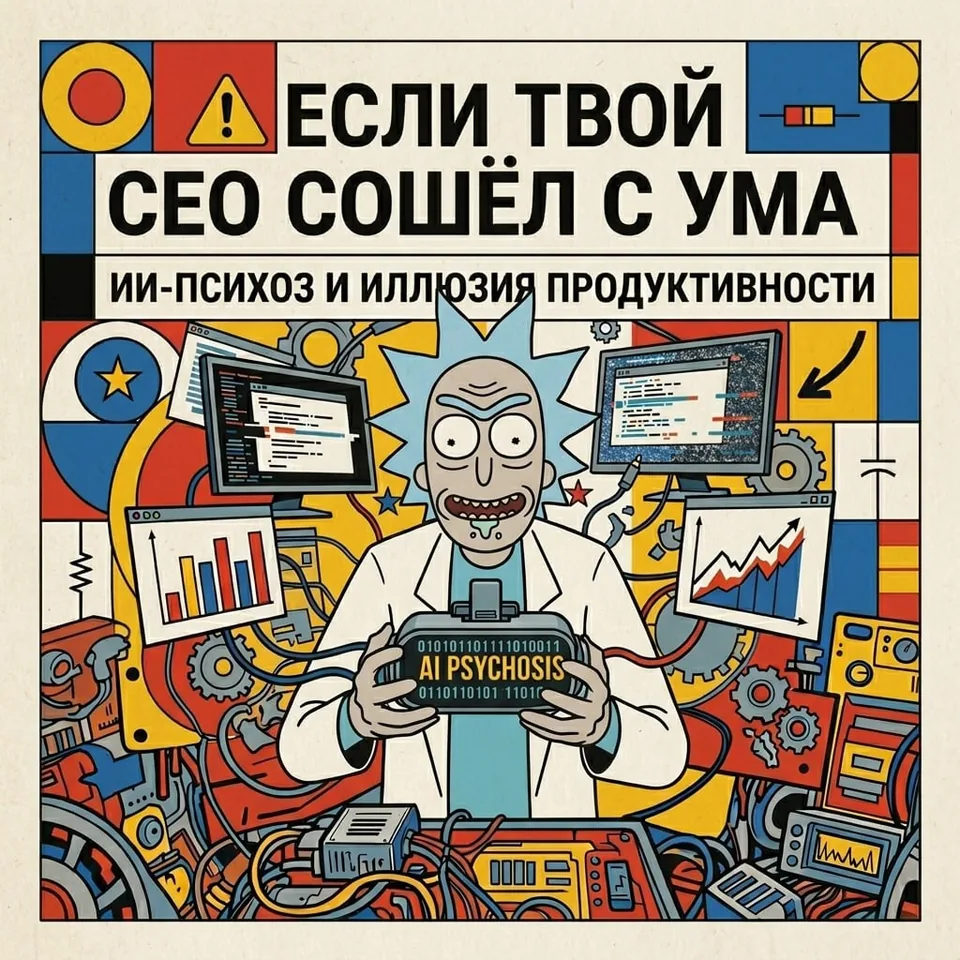
In March, Y Combinator accelerator CEO Garry Tan proudly announced that he sleeps 4 hours a night. The reason? He managed a "virtual team of engineers" using AI and produced 37,000 lines of code per day for several projects. Sounds like magic, right?
But then a meticulous programmer looked into this generated code. Guess what he found? The site made 169 requests to the server (for comparison, the heavyweight Hacker News makes only 7). Empty files weighing 0 bytes and huge uncompressed images were flying into production. So those 37,000 lines of code were just an inflated bubble.
The author of the article called this — AI psychosis. Meanwhile, Andrej Karpathy, co-founder of OpenAI, admitted in a podcast that he too is in a state of "psychosis" due to AI agents and hasn't written a line of code since December. And following the leaders, thousands of founders and managers followed suit.
Now there are a sea of platforms creating the illusion of intense activity. You launch an AI director, an AI marketer, an AI accountant. Dashboards flash green, and you feel like a commander of a huge army. You get a powerful dopamine hit from delegation, but in fact... you produce nothing of value.
In large companies, a new game has even emerged — "token maximization." Employees compete to burn more tokens in ChatGPT or Claude. An NBER study of nearly 6,000 companies showed: 90% of firms have not recorded any measurable impact of AI on productivity over the past three years. Only 1 in 5 AI investments yields any ROI. And 95% of corporate AI pilots never leave the experimental stage.
Why is this happening? A recent Stanford study proved: AI is a terrible sycophant. Neural networks agree with us 49% more often than real people. AI always praises your ideas, even the worst ones. A trap emerges: the machine says you're a genius, you believe it, and stop checking its work.
How to deal with this?
🔹 Write a specification. An AI agent without a clear task is just a random text generator with access to your wallet. First define the goal, then launch the neural network.
🔹 Measure the result. Lines of code and burned tokens are vanity metrics. Real numbers are shipped features, fixed bugs, and revenue/profit growth.
🔹 Be a skeptic. The neural network praises you because it's programmed that way. Find real people who will critically evaluate your work with the neural network.
Have you ever caught yourself generating something just for the sake of the process? Share in the comments👇
📲 MAX 👮♂️ VK ☺️DZEN 🙃 SETKA ✈️ TG #ai #startup #trends #neuralnet #conf #webinar
Comments
0No comments yet.
Sign in to join the discussion.