
The Illusion of Equality: How AI Actually Widened the Gap Between Developers 👨💻 👨💻
Many naively believed that generative AI would level the playing field between juniors and seniors. Like, the entry barrier is blurred, just write prompts and enjoy.
A massive report has been released: Developer Habits Report by the creators of Cursor (based on real telemetry from millions of development sessions from 2025 to mid-2026).
📈 The Great Divide: Top 1% vs. Median
The Gini coefficient (inequality index) for the volume of generated code is 0.77, and for token spending — 0.75. For context: this is an extreme level of stratification, worse than in the poorest resource-based economies.
🔵 Developers in the top 1% produce 46 times more AI code per day and merge 15 times more PRs per week than the median programmer.
🔵 The top 10% outperform the median by 10 times in code and 4 times in PRs.
Why is that? While the median developer uses Cursor as an advanced autocomplete (write me a function, do a migration), seniors in the p99 build autonomous agent pipelines around themselves.
🧠 Models Read More Than They Write
How the actual work with the codebase has changed:
🔵 Explosive growth of context: The ratio of input tokens to output tokens has soared from 4.5x to 11.4x. Agents spend a ton of resources to "absorb" the repository context before spitting out a line of code.
🔵 Cache is everything: Up to 90% of all token activity is
Cache Read. Those who know how to properly structure a project and keep the context "hot" get a smart agent many times cheaper.🔵 Trust without a safety net: The share of changes that are merged into commits without any manual approval has grown from 7% to 36%. More than a third of agent code goes straight to production.
💸 The Economics of Intelligence: Cheap Turns Out More Expensive
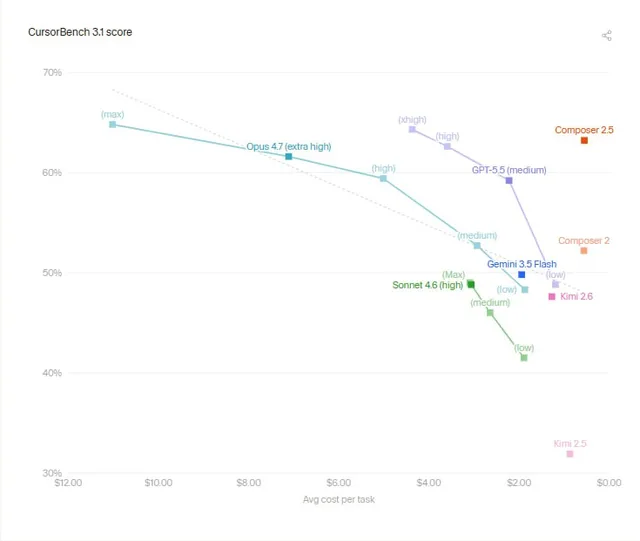
There's also an interesting slice regarding model economics. Heavy models like Opus 4.7 cost ~$1.57 per request, while lightweight ones (Composer 2.5) cost a measly ~$0.18. That's almost a 9x difference.
But if you calculate the metric "cost per accepted line of code," the gap narrows sharply.
Expensive models hallucinate less often and produce code that is less likely to be cut during refactoring and lives longer in the repository. Cheap junk ends up costing more in the long run.
No matter how hard I try to keep up with all this, I still feel like I'm at best in the middle of the adaptation process for everything new 🥲
Comments
0No comments yet.
Sign in to join the discussion.