
In the last post, I talked about how the quality of the output when working with AI depends on the model itself. But even the most expensive and advanced neural network can produce a "cheap" result. Sometimes I see colleagues throw a one-liner into the chat window like "write an electrical safety briefing" and a minute later say disappointedly: AI is weak, it just gave fluff. The problem is not the model, but the operator.
What is fed into the AI is professionally called a prompt, and the skill of working with this input is prompt engineering. My philosophy is that a prompt is not a question or a request; it is a technical specification for a performer. Just as you wouldn't tell an employee "do something about electrical safety," but instead provide context, examples, constraints, and format, the same logic applies to AI.
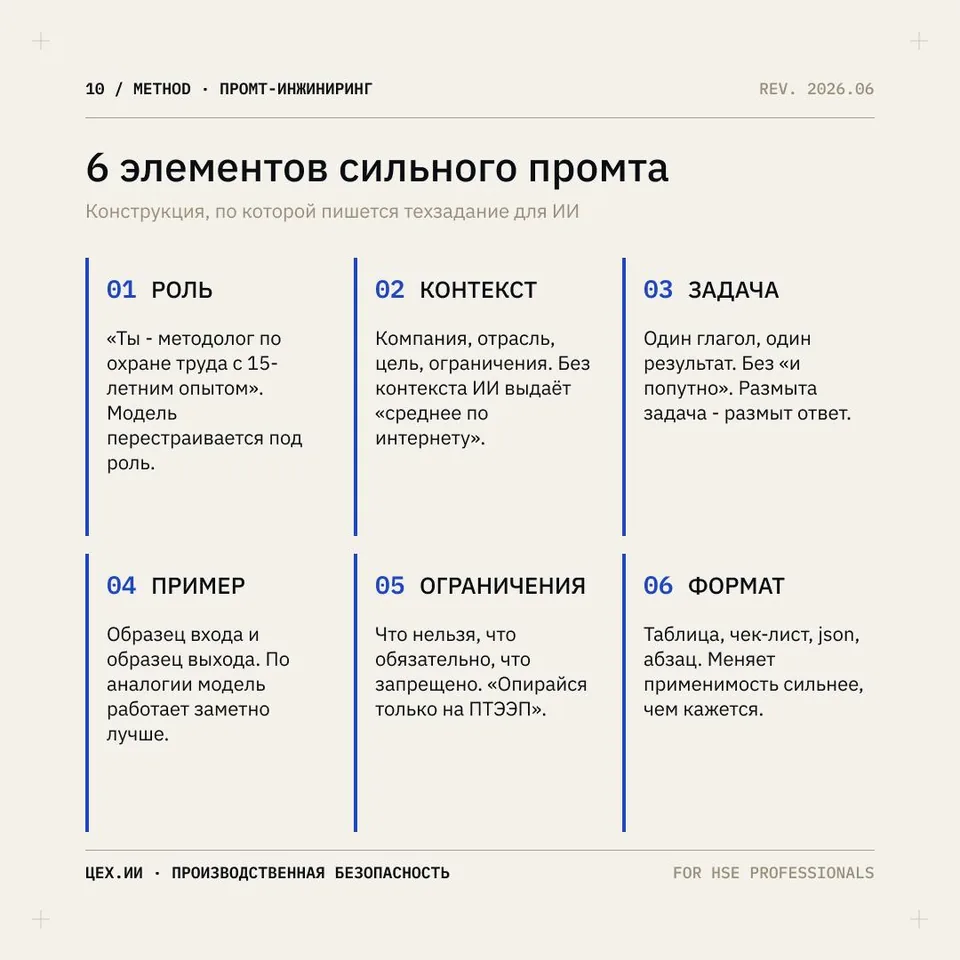
I have derived the following formula for a STRONG prompt:
1. Role. Who is speaking: "You are an occupational safety methodologist with 15 years of experience," and the model adjusts to that role—tone, density, vocabulary.
2. Context. What is important to know about the situation: company, industry, goal, environmental constraints—without context, AI produces "average internet content."
3. Task. What exactly to do: one verb, one result, no "and also." A vague task leads to a vague answer.
4. Example. Sample input and sample output: by analogy, the model works significantly better than by description. One good example saves two revisions.
5. Constraints. What is not allowed, what is mandatory, what is prohibited: "do not use anglicisms," "rely only on PTEEP," "no more than 5 points."
6. Output format. Table, checklist, JSON, paragraph for a newsletter, presentation. Format changes the applicability of the answer more than it seems.
Now about the effort, colleagues from TSEKH. One strong prompt is not five seconds; if not an hour of work, then an evening: formulating the role, finding and adapting two or three examples, up to a couple of dozen test iterations. It sounds like a lot, but then this same prompt works hundreds of times with different inputs, always returning an answer of the required quality. In terms of time savings, it is comparable to writing a good document template, but orders of magnitude more powerful.
A couple of days ago, I wrote about "consumer" and "professional" models—the same story with prompts. A consumer prompt is a single line in a chat. A professional prompt is an engineering structure that you assemble once and then operate as your professional expert asset, a competency.
Prompting is a new literacy—not a hack, not magic, but a skill that now needs to be trained just like learning to work in Excel once was. Those who have already understood this save dozens of hours a week. Those who haven't continue to be angry at AI for a poorly formulated task.
In upcoming posts, I will show specific prompts for H&S tasks: briefings, investigations, risk assessments, PPE selection. At the same time, I am collecting them into a library for colleagues from TSEKH.
So yes, dear comrades: working with AI is good. But working with the right prompt is even better.
TSEKH.AI | Telegram | MAX
Comments
0No comments yet.