
Recently, a very interesting piece AI at Work was published by BCG, one of the largest consulting firms in the "Big Three." They surveyed nearly 12,000 workers worldwide. As the title suggests, the report focuses on issues around AI in workflows in 2026. I supplemented BCG's theses with my own comments, but for my most curious readers, I'll leave the original PDF in the comments.
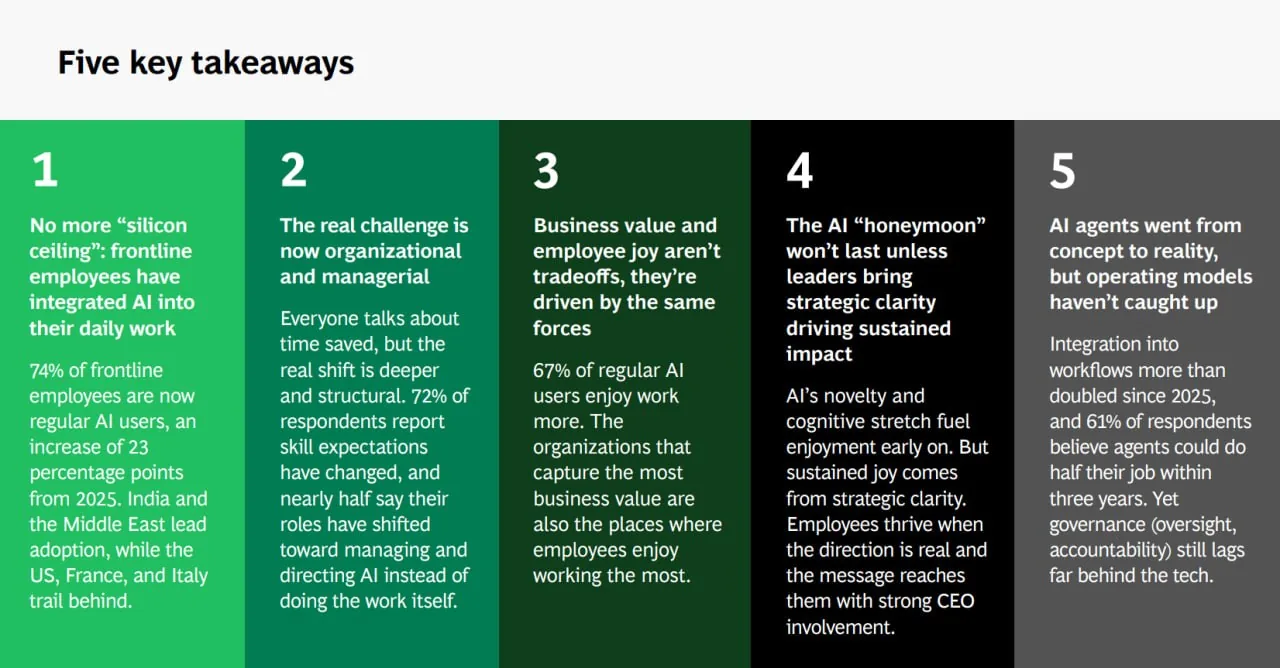
📌 Business value and employee interests when working with AI are NOT mutually exclusive tasks and are driven by the same factors.
Two-thirds of employees noted that they enjoy work more after AI implementation. According to BCG, "the same actions that benefit the business also help employees succeed." Quite logical: AI removes routine, giving employees more time for complex and creative tasks. The productivity of each individual employee increases, positively impacting business results.
📌 AI agents have rapidly become a reality from concept, but organizational processes lag behind.
Nearly 84% of respondents know about AI agents, i.e., AI systems capable of acting without human involvement. Only 30% (compared to 13% in 2025) said agents are integrated into their business processes. Meanwhile, 61% of respondents expect AI agents to be able to perform half of their work within three years. "On the ground," they feel the potential, but it has not yet been realized.
📌 AI has ceased to be a tool for a select few tech geeks and has gone mainstream.
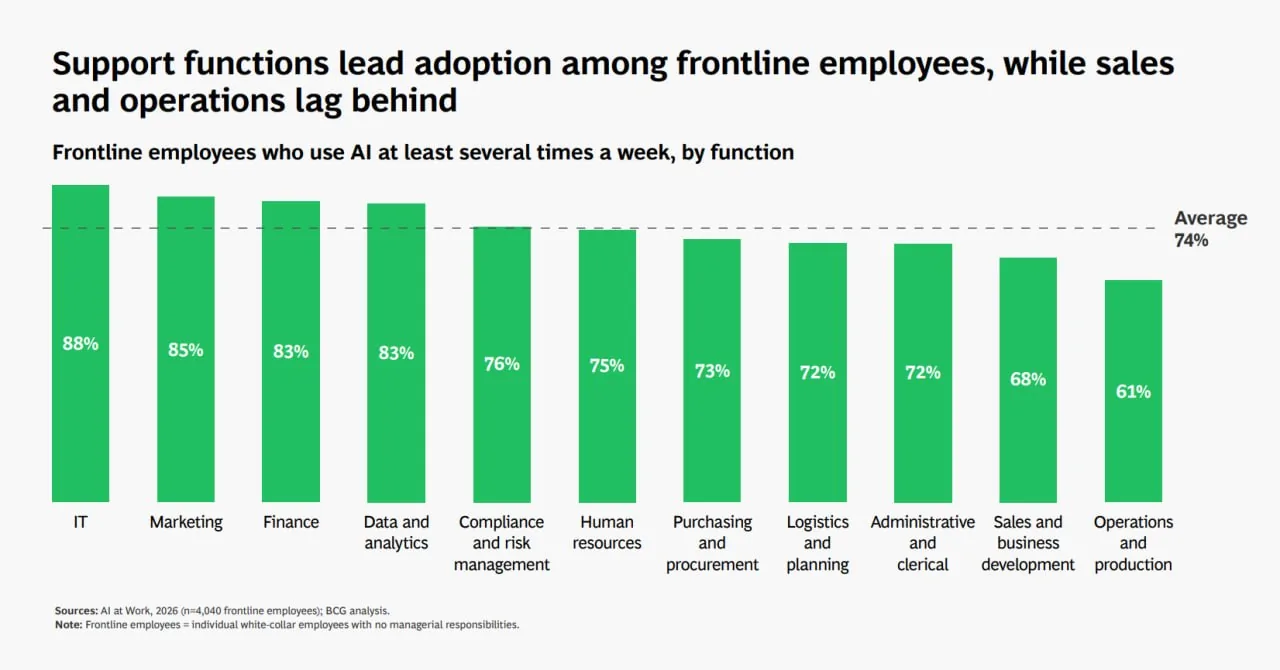
Previously, AI tools were used by advanced top management, analysts, and IT specialists. Today, it has become an integral part of the lives of ordinary workers — 74% of "white-collar" workers regularly use AI tools in their work, which is 23 percentage points more than in 2025. AI is most used in IT, marketing, finance, analytics, compliance, and HR.
By the way, 42% of employees who regularly use AI save an entire working day per week thanks to these tools. However, 66% of them do not know what to do with the freed-up time 🤡. This leads to the next, most important conclusion.
📌 The key problem today is not technology, but shitty management.
Only a third of employees believe that management clearly informs them about the AI implementation strategy. Only 36% of employees consider themselves sufficiently prepared to work with AI, and this figure has not changed since 2025.
AI has completely changed modern work: how an employee spends their day, what tasks they perform and how, how to evaluate their work, and much more. There is no need to maniacally shove AI tools into all processes just because it's trendy. It is necessary to systematically redesign work processes and create new business models. In 2026, only 42% of companies approached this issue systematically, whereas in 2025 there were half as many — 22%. This is alarming. Therefore:
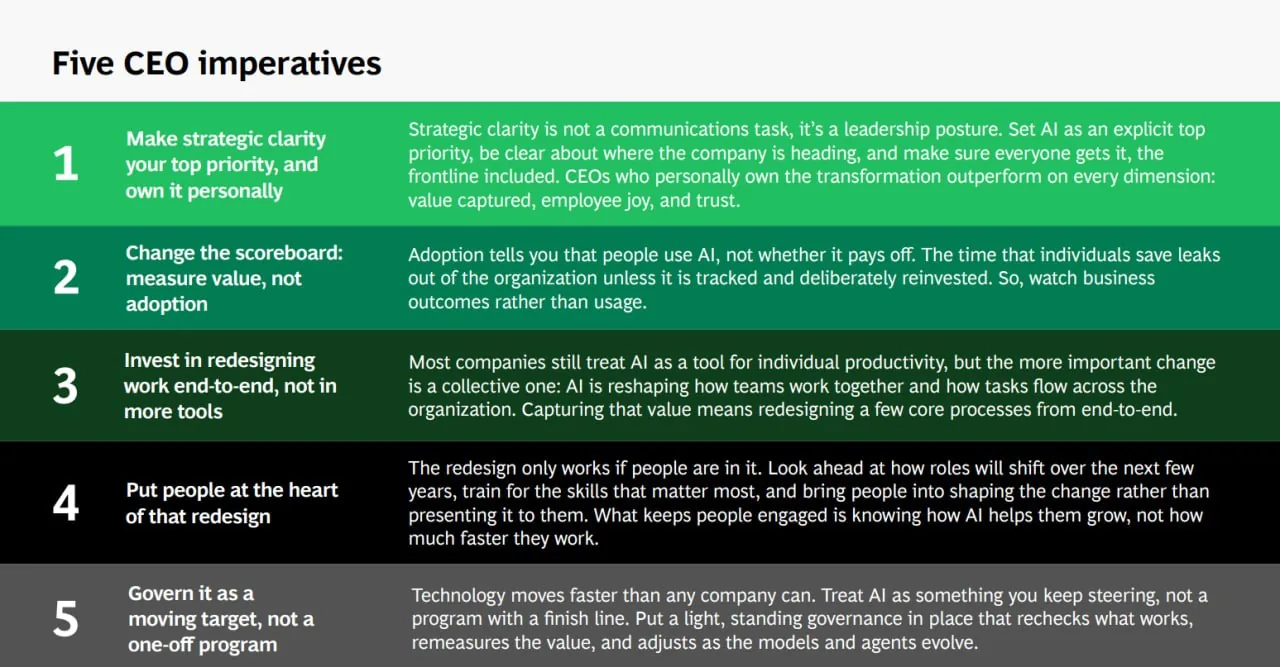
📌 A clear strategy is more important than tools for sustainable development and business impact.
One of BCG's conclusions: "employees who receive clear guidance when working with AI perform much better than those who have access to more tools." Leather bags are still a key success factor.
You need to work with people: train, adapt, communicate the value of decisions, change the methodology for evaluating their work, change work processes. Involve employees in discussions about work redesign, consider their experience and vision. Clearly indicate the direction the company is moving and ensure that everyone, including ordinary employees, understands it. Therefore:
📌Treat AI transformation not as a project with an end goal, but as a new process that needs to be managed.
Technology develops faster than we do, so implement a flexible management system that allows you to regularly try and test what works and what doesn't, evaluate value and results, and change the company as AI evolves.
AI implementation is only 20% an engineering task, and 80% change management and working with human souls. This is constantly forgotten.
Comments
0No comments yet.
Sign in to join the discussion.