
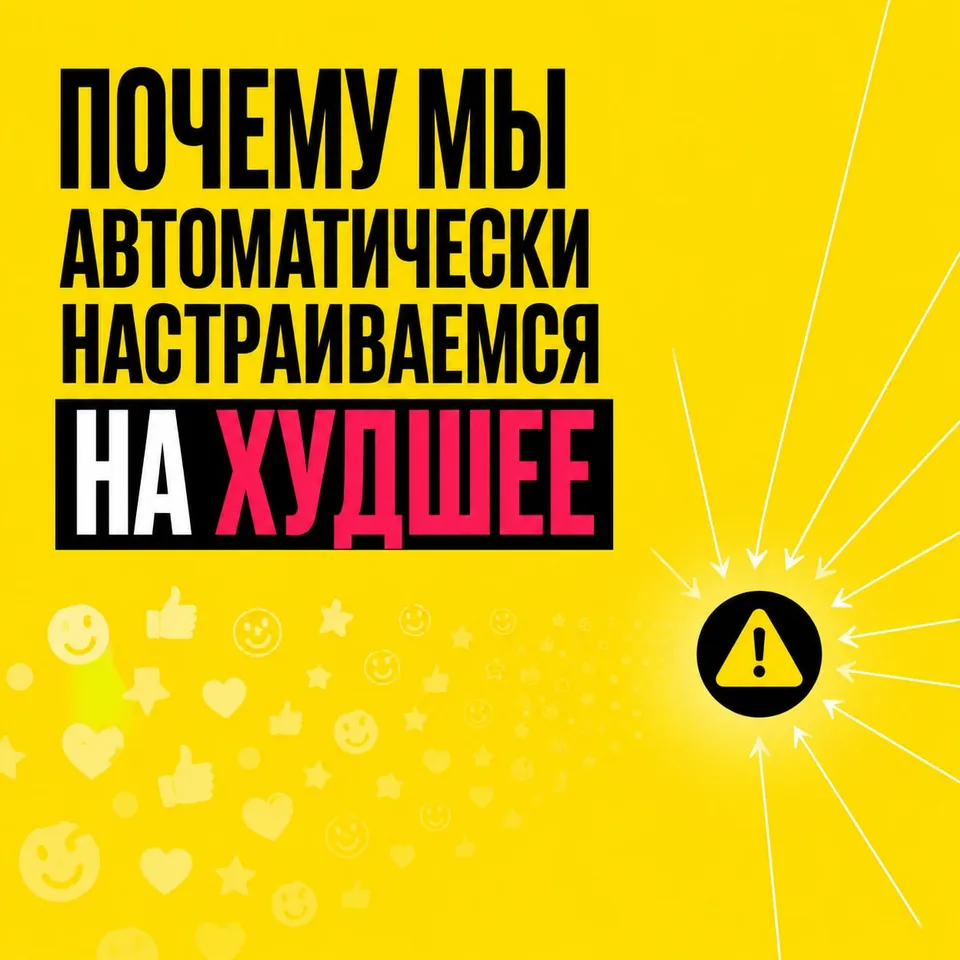
The boss writes: "We need to talk" — and your brain is already preparing for a firing. The client doesn't respond for a long time — that means they refused.
Under a post there are 30 good comments and one negative — guess what you'll be thinking about in the evening?
This isn't pessimism. In psychology, there's a well-studied effect — negativity bias: negative information gets disproportionately much of our attention.
1️⃣ Negativity automatically captures attention
In experiments by Felicia Pratto and Oliver John, people were shown positive and negative words and asked to name the color they were written in as quickly as possible.
On negative words, people responded slower, even though their meaning was irrelevant to the task. And later they remembered the negative words better.
The researchers called this — automatic vigilance.
The brain seems to say: "Stop. There might be something dangerous here."
2️⃣ The brain reacts more strongly to bad things
In an experiment by Tiffany Ito and colleagues, people were shown positive, negative, and neutral images while their brain's electrical activity was measured.
Negative images caused a stronger reaction than positive ones. So, good and bad news of equal emotional strength are not equivalent to the brain. Bad news usually weighs more.
3️⃣ We notice threats faster
In an experiment by Arne Öhman and colleagues, people had to find a different object among many images.
A snake among flowers or mushrooms was found faster than a flower among snakes.
One common interpretation is evolutionary.
Missing something good is unpleasant. Missing a threat could once cost a life. So the brain still prefers to look for danger first.
4️⃣ Losses affect us more than gains
This is clearly seen in the classic experiments by Kahneman and Tversky. When people were offered a guaranteed 3000 or an 80% chance of getting 4000, 80% chose the guaranteed win.
But when it came to losses — guaranteed loss of 3000 or an 80% chance of losing 4000 — 92% chose the risk. Just to avoid a guaranteed loss.
Moreover, the effect proved quite robust. In 2020, the study was replicated with 4098 participants from 19 countries. 94% of individual results and 12 of 13 key effects were reproduced. The results were published in Nature Human Behaviour.
And here's what's interesting.
When we think about the future, the brain doesn't necessarily choose the most likely scenario. It notices the most dangerous one faster.
So:
"he doesn't respond" → "something happened"
"the project is delayed" → "we'll fail everything"
"the boss wants to talk" → "I'm in trouble"
Perhaps, instead of fighting such thoughts, it's more useful to ask yourself one question: What actually happened, and what has my brain already filled in?
📲 MAX 👮♂️ VK ☺️DZEN 🙃 SETKA ✈️ TG #management #negativity #research
Comments
0No comments yet.
Sign in to join the discussion.