
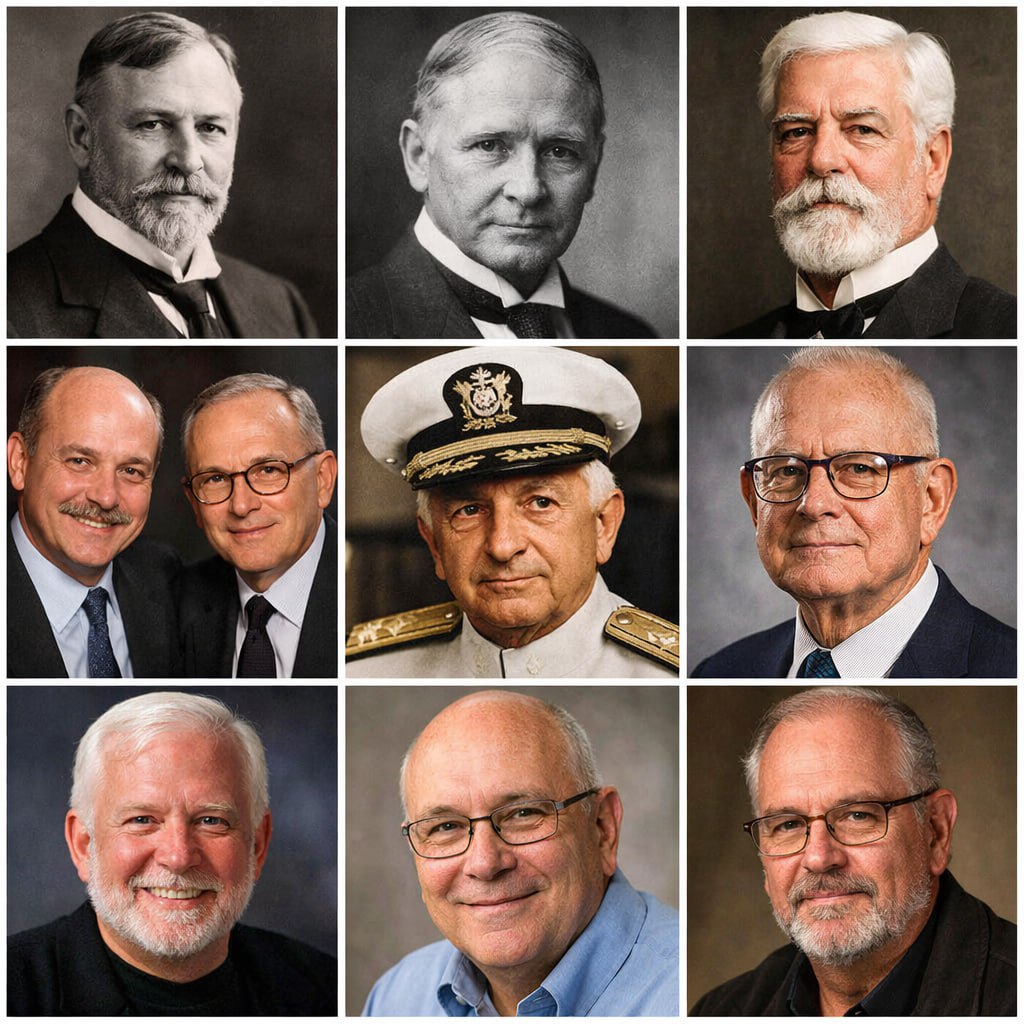
Let's look at key historical figures who influenced the development of project management.
🔴 Henry Gantt in 1910 in his book "Work, Wages, and Profits" first published the Gantt Chart, which allows managers to visualize project tasks, their duration, and interdependencies.
🔴 Frederick Taylor: Father of scientific management. Published in 1911 "The Principles of Scientific Management", focusing on efficiency, time-saving methods, and task breakdown for unskilled workers, laying the foundation for systematic management.
🔴 Henri Fayol. Formulated 5 management functions: planning, organizing, motivating, coordinating, and controlling.
🔴 Walker Hard and Kelly Morgan in the 1950s, working at DuPont and Remington Rand, developed the Critical Path Method. It helps calculate the minimum project duration by identifying the longest chain of interdependent tasks. First applied to chemical plant maintenance, reducing downtime by 25%.
🔴 Admiral Hyman Rickover led the development of the PERT (Program Evaluation and Review Technique) system in 1958 for the Polaris missile project. A method for evaluating projects with high uncertainty. PERT uses three time estimates: optimistic, pessimistic, and most likely.
🔴 Edwards Deming. Although better known for quality, his PDCA (Plan-Do-Check-Act) cycle became the Bible of iterative management. Continuous process improvement. Without it, modern Agile and Lean would not exist. After World War II, his ideas helped Japanese industry (including Toyota) achieve an economic miracle.
🔴 Jeff Sutherland and Ken Schwaber — authors of Scrum, introduced to the world in 2002. They shifted from rigid plans to short sprints, self-organization, and constant adaptation to change. Initially, the methodology was created for IT.
The first professional management organization (IPMA) appeared only in 1965, PMI in 1969, and the familiar PMBOK knowledge guide was published only in 1987!
If I forgot someone, write in the comments 👇
TG | MAX | VK | DZEN | #product #project #history #development #evolution #history
Comentários
0Ainda não há comentários.
Entre para participar da conversa.