
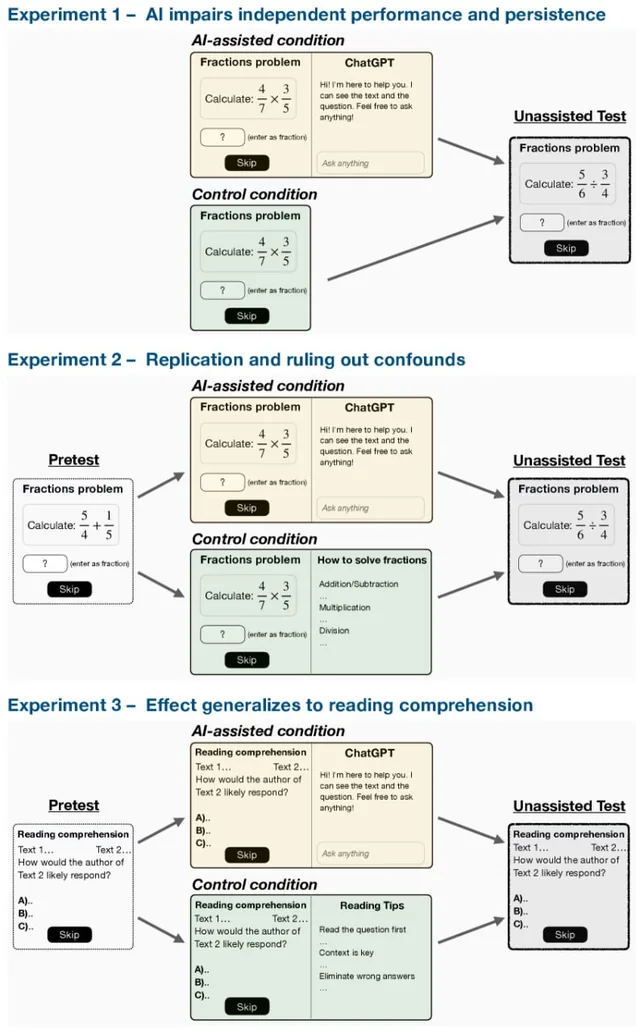
Scientists from MIT, Oxford, and CMU published a large study (1200+ people) on how AI assistance affects our independence. Spoiler: it turns people into cognitive invalids.
Researchers gave people tasks to solve. One group was given an AI assistant that instantly provided answers, the other got nothing.
And what happened?
1️⃣ Short-term boost: With AI, people solved tasks faster and more accurately. Obviously.
2️⃣ Catastrophe when removed: As soon as AI was taken away, the "trained" group performed worse than the control group that had struggled on their own.
3️⃣ Atrophy of will: The worst part—people from the AI group started skipping tasks en masse. They simply refused to think independently.
This effect took only 10-15 minutes of working with the neural network. Imagine what happened to the brains of vibe coders 🫠
👉🏻 But there is one critically important nuance
The decline in skills and motivation was observed only among those who asked AI for ready-made answers.
Participants who used the neural network in hint and guiding question mode did not degrade and retained the ability to solve problems independently.
The authors highlight two scientifically grounded mechanisms:
🔵 Hedonic adaptation. When AI generates an answer in seconds, the brain shifts its reference for how long a task should take. As a result, writing code independently begins to feel subjectively like an inadequately high energy cost.
🔵 Broken metacognitive calibration. By being deprived of productive struggle, a person loses understanding of what they are truly capable of. The lack of independent attempts deprives the brain of feedback about its own skills.
The authors summarize the problem with the metaphor of a "boiling frog." Each delegation of a task to a neural network seems locally beneficial and free, but the cumulative effect imperceptibly yet radically erodes the ability to solve complex problems without a technological crutch. Current AI systems are optimized solely for short-term utility, not for the long-term development of the user.
Comments
0No comments yet.
Sign in to join the discussion.