
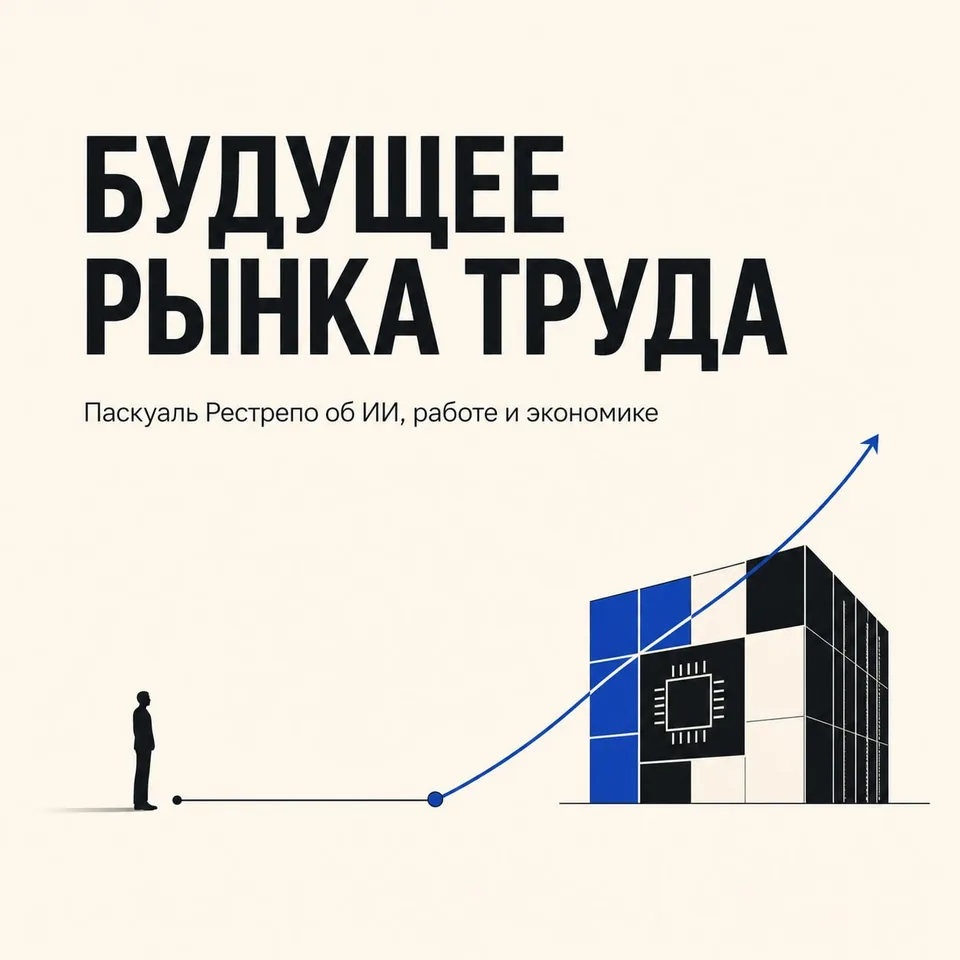
Pascual Restrepo is a person who has spent many years trying to understand how AI affects the economy: employment and wages.
He was born in Colombia, studied mathematics and economics, defended his dissertation at MIT, and today teaches at Yale University.
A significant part of Restrepo's research was written together with Daron Acemoglu, his academic advisor and winner of the 2024 Nobel Prize in Economics.
Together they proved: technological progress does increase productivity, but its benefits are not necessarily distributed evenly among people.
Recently, Restrepo gave a lengthy interview — Pascual Restrepo on AI, automation, and the future of work
Here are a few key thoughts from that conversation
1️⃣ Automation replaces not professions, but individual tasks.
When a welding robot appears at a car factory, it doesn't necessarily destroy all jobs. It takes over a specific operation, while people continue to perform the rest of the production process. Therefore, it's more accurate to ask not "will the profession disappear?", but "which tasks within it can the machine perform?".
2️⃣ Artificial intelligence changes the rules of the game
Previous software automated mainly what a person could write precise instructions for in advance. Modern AI learns from examples. Thanks to this, it can master tasks based on experience, observation, and implicit knowledge — that is, skills that people cannot always explain in detail.
Restrepo admits that theoretically, AI could learn to perform almost any human job. If you observe a person's actions long enough, collect enough examples, and allocate the necessary computing power.
The transition will be slowed by the cost of infrastructure, shortage of computing power, public institutions, and the simple desire of people to continue interacting with other people — for example, with teachers, doctors, or consultants.
3️⃣ Furthermore, even a very powerful AI will face competition for computing resources. If the same AI can be used to automate a lawyer's work or to find a cure for cancer, develop energy, and solve climate problems, the most valuable tasks will get priority.
This is where the most interesting part begins.
Throughout economic history, the main constraint on production has been human beings. For the economy to grow, more workers or more productive workers were needed.
In the AI economy, the constraint may no longer be human labor, but computing power: chips, servers, data centers, and energy. Production will scale not by hiring people, but by adding computing power.
At the same time, lower wages will not necessarily automatically lead to a lower standard of living. If AI drastically cheapens goods and services, a person will be able to buy more even with a lower nominal income.
4️⃣ But such an optimistic scenario is only possible with a wide distribution of benefits. If automation affects a small group of professions, and other prices remain almost unchanged, it is precisely the representatives of these professions who will suffer real losses.
More important is to understand what place it will occupy in the new economy and who will get the wealth it creates.
People may continue to work, but economic growth will depend less and less on their labor. If the main resource becomes computing infrastructure, the bulk of new income may go to its owners.
To summarize, the main question of the future sounds like this: "How to distribute the income from a company in which a person will cease to be the main constraint on growth?"
📲 MAX 👮♂️ VK ☺️DZEN 🙃 SETKA ✈️ TG #ai #ии #нейросети #интервью
Comments
0No comments yet.
Sign in to join the discussion.