
I started this post as a review of the updated PMO Value Ring standard (which I certified a couple of years ago), but in the process I caught a powerful insight. So read to the end — it's not just about methodology.
Project offices are no longer divided into "supportive" or "strategic." PMI has released a fresh guide, "Project Management Offices: A Practice Guide." The main paradigm shift: we choose not the type of structure, but the value it brings to stakeholders.
The essence of the new architecture
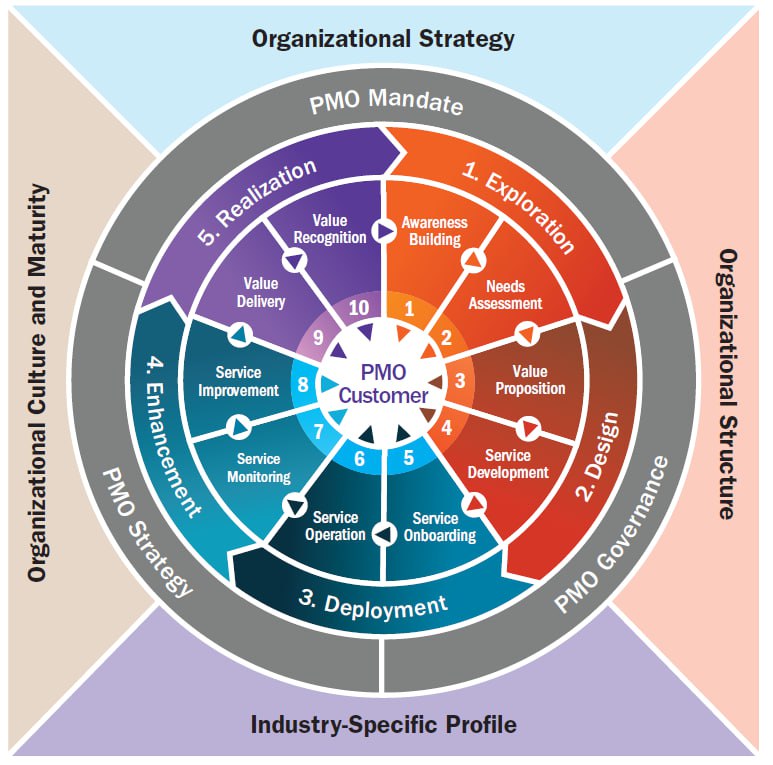
At the center of everything is the PMO Client (executives, managers, product owners). The entire office is built around their pains and needs. The framework rests on four pillars: organizational baseline elements (culture and strategy), structural components (mandate and authority), the customer experience cycle (from exploration to value delivery), and an operational flywheel of 10 steps that turns PMO services into a continuous flow of benefit.
Four pillars of an effective PMO:
— Context (Organizational Baseline): The framework requires considering the company's strategy, maturity, and even industry specifics. What works in an IT startup will kill a project office in an industrial giant.
— Foundation (Structural Components): A project office needs a clear Mandate (authority) and strategy. Without an official voice and understanding of its goals, the PMO becomes a structure with blurred responsibility.
— Customer Experience Cycle: This is a five-stage interaction model. We first explore needs (Exploration), design services for them (Design), deploy them, continuously improve, and finally demonstrate real benefit (Realization).
— Value-Generating Flywheel: This is the "engine" of the operational model with 10 steps. It turns PMO work into a continuous process: Awareness Building → Needs Assessment → Value Proposition → Service Development → Service Onboarding → Service Operation → Service Monitoring → Service Improvement → Value Delivery → Value Recognition → and back to the beginning. Each revolution makes the organization more efficient.
Until recently, the standard was a Data-driven approach — decisions based on metrics. Now we have moved into the era of Value-driven, where the delivery of value to the client is paramount. It is logical to ask, what will be next?
The next stage is Purpose-driven management. This is decision-making based on global meanings and long-term mission. Management will stop focusing only on profit or local benefit: the priority will be how the project changes the industry landscape and society as a whole. At least on paper.
The evolution of decision-making looks like this:
Control (Process) → Analysis (Data) → Benefit (Value) → Meaning (Purpose)
And you know what? Management is becoming more and more "ephemeral." Previously, metrics were a solid support: numbers go up — you're good, they go down — bad work. Everything was transparent. Now, management increasingly relies on feelings and meanings rather than facts. Are we definitely turning in the right direction, or are we just losing ground under our feet?
TG | MAX | VK | DZEN | #project #product #management #pmo #value #standard
Comments
0No comments yet.
Sign in to join the discussion.