
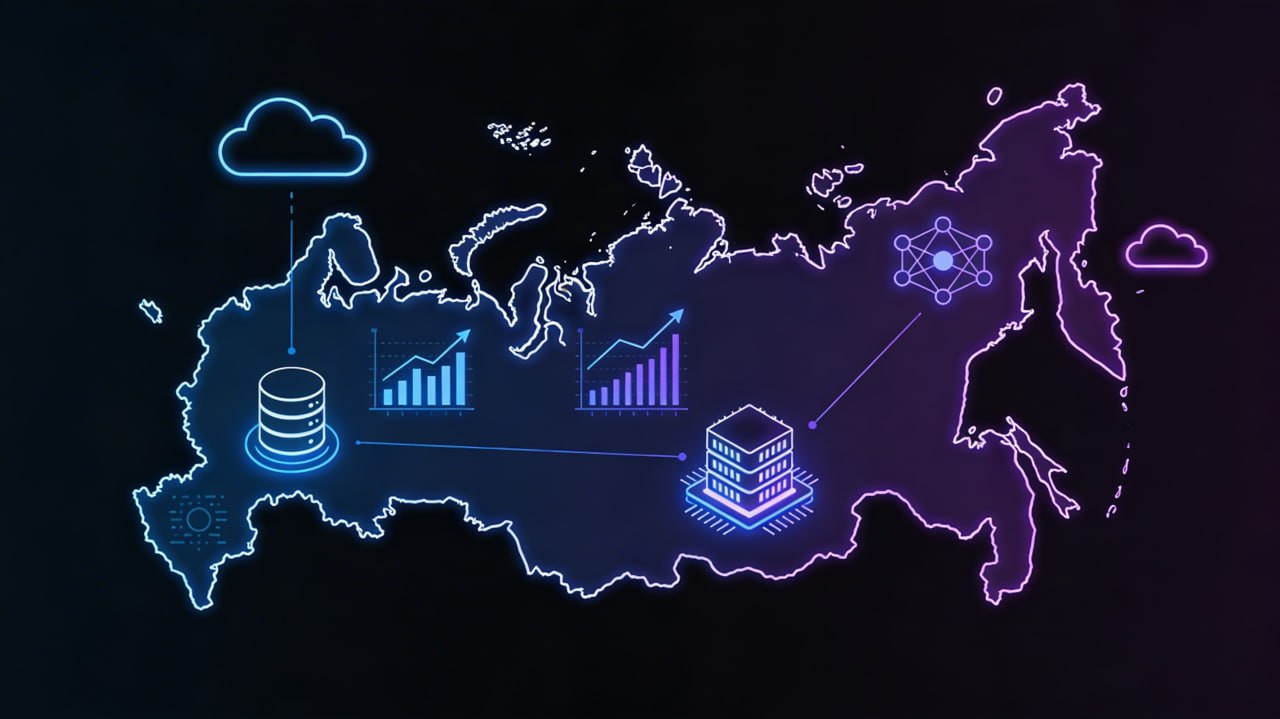
Clouds as the Engine of Digital Transformation in Russia 🚀
The Russian cloud market grew by 30–35% in 2025, approaching the mark of ~400 billion RUB – clouds have become the fastest-growing segment of the IT market and essentially the basic infrastructure for AI projects and digital transformation of businesses.
🏎 What accelerated the market:
Shortage of hardware, especially server GPUs – companies find it easier and faster to take resources from the cloud than to build their own data centers.
Explosive interest in AI: from experiments with generative models to deploying AI agents in support, sales, logistics, and analytics processes.
Tighter requirements for data protection and sovereignty: businesses find it increasingly difficult to maintain the required level of security on-prem, while clouds offer certified environments and ready-made services.
⛅ Yandex Cloud and architecture evolution:
Strong drift toward hybrid model: combining own capacities and public cloud, unified network and end-to-end monitoring.
Focus on generative models and AI agents as a service: ready-made LLMs, tools for orchestrating chains, integration with customer data.
☁️ Trend 2026: from "virtualization farms" to cloud platforms:
Consolidation of a zoo of virtualization clusters into full-fledged clouds with a unified panel, API, and cost management services (FinOps).
For the customer, this is a transition from "VMs on demand" to a platform model: service catalogs, PaaS, managed databases, queues, monitoring, data pipelines.
⛔️ Import substitution and moving away from VMware:
Mass abandonment of VMware and integration of Russian virtualization and containerization stacks have become a separate driver for migration to Russian clouds.
A critical question for 2026–2027: how to combine rapid migration, resilience, and transparent resource consumption economics.
🧑🔬 What HSE research says about IT trends in Russia:
Data economy – data as an asset and the foundation of product strategy.
DSLM (Data & Software Lifecycle Management) – managing the lifecycle of data and software as a unified system.
Low-code / no-code – accelerating the launch of digital products, especially at the level of internal back-office and front-ends.
AI agents – automation of business processes on top of corporate systems.
XaaS – "everything as a service": from infrastructure to industry-specific IT platforms.
All these trends converge at one point: Russian clouds are ceasing to be "cheap virtual machines" and are becoming the engine of digital transformation — from AI pilots to industrial operation in secure, cost-managed platforms.
Comments
0No comments yet.
Sign in to join the discussion.