
In my previous post, I talked about my BDSM-like experience of job searching for 4 months and >900 rejections. For everyone looking for a job or planning to, I continue the series of posts on this topic. Today, let's talk about what's wrong with the labor market and the hiring process.
The service hh.ru reports that in February 2026, the hh.index in Russia was 9.8. According to the methodology, an index above 8.0 means "high level of competition among job seekers for jobs, employer's market." But 9.8 is the "average across the board." The most problems are observed in marketing and PR (23.5), IT (19.6), and among all "white-collar" workers in general. There's no other way to describe it but a bloody ocean and a massacre for vacancies. Only blue-collar jobs remain on the candidate's side, so everyone rush to the factory.
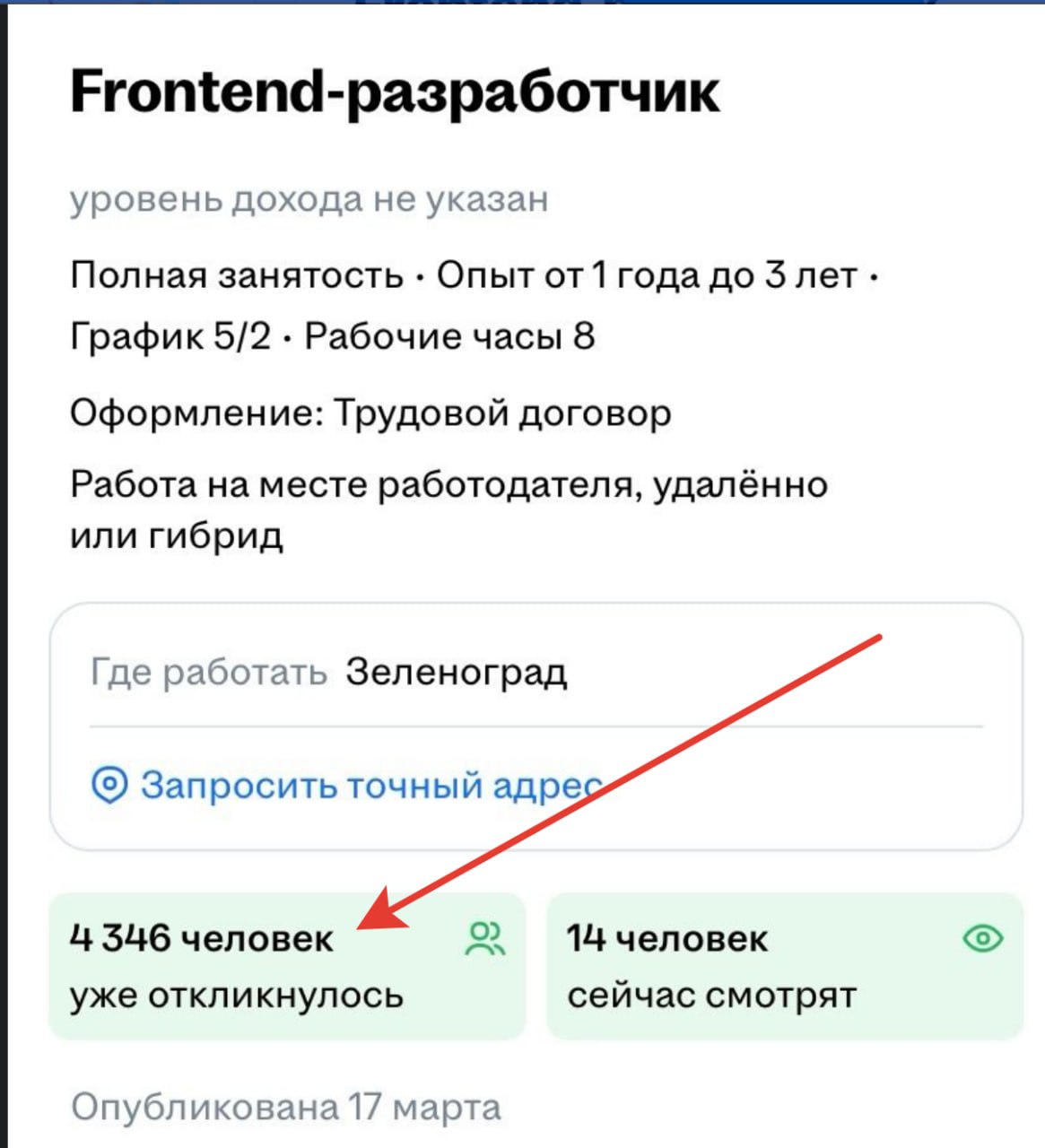
Unsurprisingly, recruiters have long been overwhelmed by a flood of responses from job sites and are gradually moving away from manual selection. The example of the vacancy above is particularly illustrative: in 8 days, the vacancy gathered almost 4,500 responses; it's physically impossible to sort through them manually alone. And a recruiter usually handles several such positions simultaneously.
This is where so-called ATS (Applicant Tracking Systems) come into play, increasingly supplemented by AI tools. Simply put, this is software that has been given the most routine and labor-intensive stage—resume screening. ATS looks at resumes, compares them with the job requirements, and if the match in experience, skills, keywords, and conditions is high enough, it passes them on to the recruiter. If not, the resume is simply ignored. AI allows for fuzzy search, meaning searching by meaning rather than keywords, but the essence of the solution doesn't change.
Fortune magazine reports: 75% of candidates never reach human recruiters. In Russia, the figure is lower: according to hh.ru, 55% of companies use ATS, although personally I feel it's much more. We are at the mercy of soulless machines 🤖.
The implementation of such solutions is fully justified: almost every business that has implemented them notes a significant economic effect. But for us, ordinary workers, this has created additional difficulties because breaking through the ATS has become difficult regardless of whether you are a beginner or already a Smesharik—the conversion rate barely exceeds 3-4%. Part of the problem lies in the flawed configuration of the ATS themselves, and partly in the flawed algorithms of job sites. For example, here's a story of a programmer who instead of describing experience inserted a recipe for dumplings into his resume and still got an invitation for an interview. And you keep talking about your Moscow State University diploma 🙃.
At the same time, ATS treats symptoms, not the cause. It reduces the company's resource losses during hiring but does not solve the main problem: the huge flow of non-targeted responses, low conversion to hire, and high costs for the entire process. Therefore, about 30-40% of vacancies are not published on open platforms at all. Instead, referral programs, direct sourcing, and closed channels are gaining increasing popularity because they most often bring the most motivated employees and achieve the highest conversion at low cost.
It's important to note that everyone is struggling now: job seekers can't find a decent job, and employers can't find a decent employee, which gives rise to numerous selection stages. For example, I went through as many as 8 stages spanning two months.
One could discuss the reasons for this state of the market at length, but that's no longer so important. What's much more important now is to understand how to search for a job in these realities.
My unsolicited advice—in the following materials.
Comments
0No comments yet.